



TL;DR
- Post-meeting admin is not one task. It is nine distinct bottlenecks, and they fail in different ways: the write-up, the ownership, the filing, the finding, and the catching-up.
- The best-evidenced failure happens at the close, not afterwards. Two large independent surveys agree: 54% of knowledge workers frequently leave meetings unclear on next steps or who owns them, and 55% report unclear next steps after meetings.
- AI removes the transcription and drafting bottlenecks outright. It removes the filing bottleneck only if the tool writes into your actual trackers rather than its own. It does not fix an invite list with no stated goal.
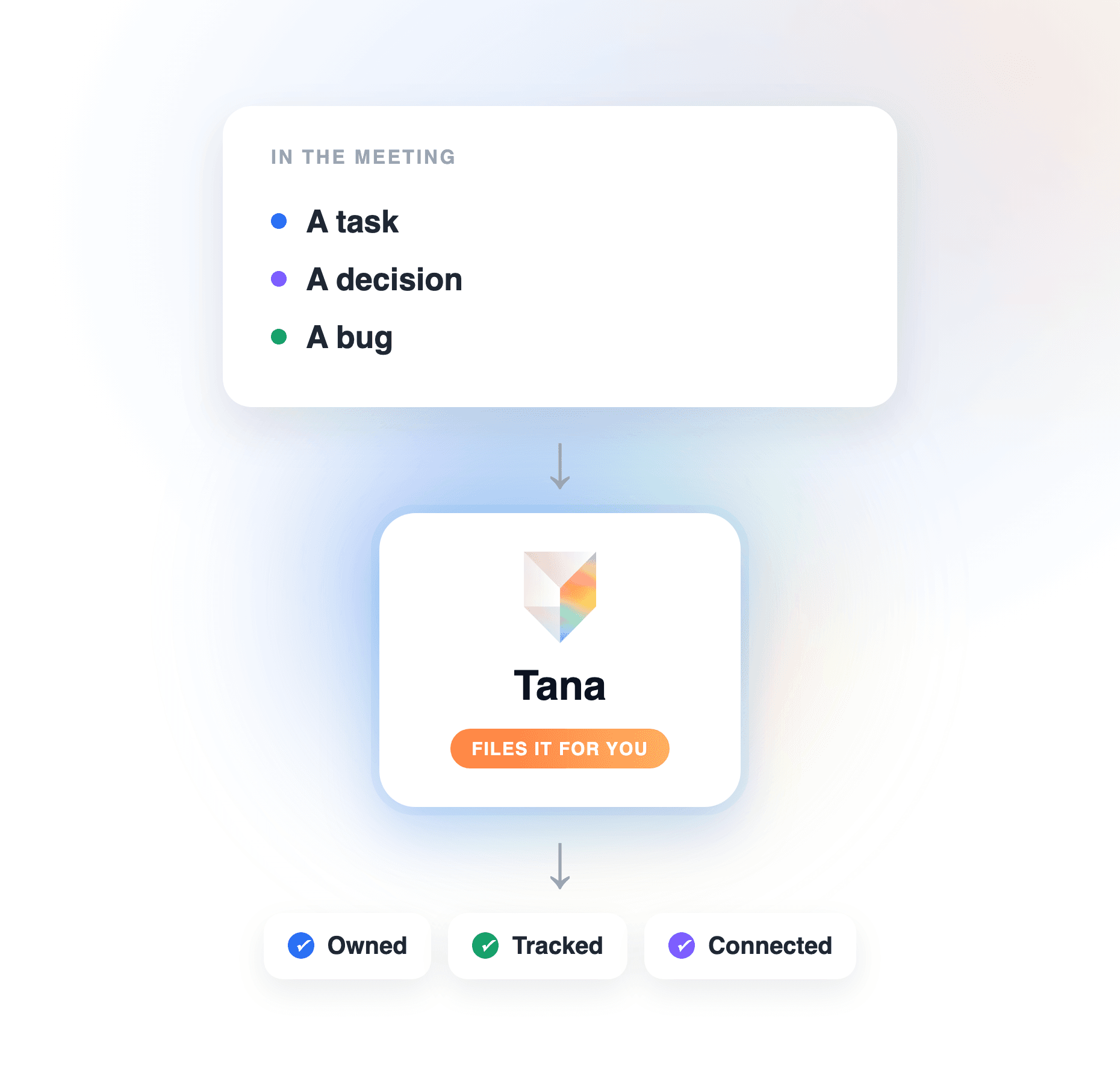
- Tana attacks the ones that automation can genuinely close: it captures without a bot, turns the conversation into typed records with owners, files them into the tools you already use as proposals you approve, and updates the record you already have instead of writing a new summary each time.
The work does not end when the call does. Somebody writes it up, somebody files the tickets, somebody tells the people who were not there, and somebody rediscovers three weeks later that it was all decided already. This is the part of meeting culture that gets the least attention and produces the most rework. Below are the nine bottlenecks, what the evidence actually says about each, and an honest read on which ones AI removes and which it only shortens.
1. Nobody leaves knowing what happens next
This is the one to fix first, because it is the best-supported finding in the whole field and everything downstream depends on it. Atlassian's 2024 survey of 5,000 knowledge workers found 54% frequently leave meetings unclear on next steps or who owns which task. Microsoft's 2023 Work Trend Index, covering 31,000 people across 31 markets, independently found 55% report unclear next steps after meetings. Two different methods, one point apart.
What AI removes: the extraction. A model listening to the conversation will reliably surface the commitments people made and who made them, which is the part humans skip when the meeting runs over.
What it does not: the decision itself. If the room never agreed who owns something, no tool can invent it. Good ones leave it unassigned rather than guessing, which is what Tana does when the conversation is genuinely ambiguous.
2. The write-up never gets written
Microsoft's same 2023 survey found 56% find it hard to summarize meeting outcomes, and 80% said they would hand summarizing meetings and action items to AI given the chance. That is the clearest mandate in the data: of all the work people want to give away, this is top of the list.
What AI removes: this one completely. Automatic summarization is the most mature capability in the category and it is now table stakes. In Tana, the meeting's summary and outline refresh as the call runs rather than waiting for someone to sit down afterwards.
3. The write-up exists but the work is not filed anywhere
A summary that says "Ana will fix the onboarding bug" is a sentence. A filed issue in your tracker, with a component, a severity and an owner, is work. Most tools produce the first and leave you the second, which is why the admin persists even after teams adopt a notetaker.
What AI removes: only if the tool writes into your systems rather than its own. This is the sharpest dividing line in the category. Many meeting assistants create tasks inside their own interface, or push a list of takeaways into a document. Tana files into the tools you already run on, including Linear, Jira, GitHub, Slack and HubSpot among others, and each one arrives as a proposal you approve before anything is created.
4. The meeting ends by booking another meeting
The same Atlassian survey found 77% regularly attend meetings that end by scheduling another meeting. Some of those are legitimate. Most are a decision that could not close because the information was not in the room.
What AI removes: part of it. If the missing information is something your team already discussed, decided or filed, an assistant that can search your own record can put it in the room instead of scheduling a second meeting to go and find it. Asking chat what was decided about something returns the answer with a link to the meeting it came from.
What it does not: a meeting that needs a person who is not there still needs that person.
5. Decisions get made twice because the first one cannot be found
Atlassian's State of Teams research found 55% find it hard to track down the information they need, and its 2025 edition, covering 12,000 knowledge workers, put the cost at roughly a quarter of working time spent searching for answers. Meanwhile 50% had discovered only after the fact that another team was doing duplicate work, and Asana's 2022 index of 10,624 knowledge workers put duplicated work at 129 hours per person per year.
What AI removes: the searching, if the record is structured. A transcript archive gives you keyword search. A record where the decision is its own item, linked to the project and the meeting it came from, answers "why did we do it this way" directly. This is where Tana's typed records matter more than its transcription.
6. The record goes stale because each meeting writes a new one
Ten weeks into a recurring meeting, a summary-per-meeting tool has left you ten documents describing an evolving situation, and the current state of play is in none of them. So people stop reading them, which recreates bottleneck five.
What AI removes: this is the least common capability and the most useful one. When Tana extracts an outcome it first searches the whole workspace for a record that is already the same thing, the same bug, the same customer, the same decision, and updates that record rather than creating a duplicate. Pin a project document to a recurring meeting and each call folds into it. What you get after ten weeks is one current record.
7. People attend defensively because there is no reliable record
If the only way to know what happened is to be there, everyone comes. A 2022 survey of 632 US employees led by Steven Rogelberg at UNC Charlotte found people averaged 17.7 meetings a week while judging only 11.8 critical to attend, wanted to decline 31% of invitations but declined 14%, and 71% said they would skip unnecessary meetings if given quality notes afterwards.
What AI removes: the excuse. A trustworthy automatic record is the precondition for anyone feeling safe declining. It does not by itself change the culture, and in that study 78% of managers had never discussed declining meetings with their reports, so the tool is necessary and not sufficient.
8. Whoever missed it cannot catch up
Microsoft's 2023 survey found 57% struggle to catch up when joining a meeting late, and its June 2025 report found 57% of meetings are now ad hoc, with no calendar invite at all. The second figure is the harder problem: a capture method that depends on a scheduled event misses more than half of what happens.
What AI removes: both, if capture is not tied to the calendar. Tana captures from the desktop app on macOS and Windows using your machine's own audio, so it covers Zoom, Teams and Google Meet, and an ad-hoc conversation that was never scheduled, without a bot joining.
9. Doing the admin costs more than the admin
The last bottleneck is the switching itself. A 2022 instrumented study by researchers at Harvard Business Review, covering 137 users across three Fortune 500 companies for up to five weeks, found workers toggled between applications around 1,200 times a day, adding up to just under four hours a week reorienting, roughly 9% of working time. Sophie Leroy's attention-residue research explains why the meeting write-up is a particularly expensive item on that list: switching away from an unfinished task degrades performance on the next one, and an un-written-up meeting is exactly that.
What AI removes: the switch. Work drafted during the call and approved in one place never becomes a separate errand. In Tana you can turn any stretch of the conversation into a typed record, an artifact or a skill run while the meeting is still running, and it appears live for everyone in the room.
What automation does not fix
Being honest about this is the difference between a useful list and a sales pitch.
A meeting with no stated purpose. Atlassian found 62% attend meetings with no goal in the invite. No amount of post-processing rescues that.
The wrong invite list. Automation makes an unnecessary meeting cheaper to skip, not unnecessary.
Fabricated action items. A model asked to find commitments will occasionally find one nobody made, or attach the wrong owner. This is the real risk of leaving extraction unattended, and it is why an approval step matters: in Tana, AI proposes and you accept, and updates and deletions always require your say-so.
Proving it worked. Nothing here produces a chart of admin hours saved. What it produces is a record you can interrogate: which follow-ups from last month are still open, which decisions came back. That answers more than a dashboard would, but you have to ask it. See 10 meeting metrics product teams should track in 2026.
Where to start
Fix bottlenecks one and three first. They compound: unclear ownership makes filing impossible, and unfiled work recreates every other problem on this list. Everything else gets easier once the meeting reliably ends with owned, filed work.
For the method rather than the tooling, see How to keep meeting action items from getting lost and How to cut meeting overload for managers in 2026.
Frequently asked questions
How much time do teams spend on post-meeting admin?
Nobody has measured it directly, and any specific figure you see quoted for it is unsourced. What is measured are the surrounding costs: around a quarter of working time spent searching for answers, 129 hours per person per year on duplicated work, and just under four hours a week lost to switching between applications. The honest summary is that post-meeting admin is a large share of what Asana calls work about work, which its research put at roughly 60% of knowledge-worker time. Tana attacks it by producing the filed work during the call instead of queuing it for afterwards.
Can AI really reduce post-meeting admin work?
Yes, for three of the nine bottlenecks outright: transcription, summarizing, and extracting action items with owners. It reduces a fourth, filing, but only if the tool writes into your actual trackers rather than creating tasks in its own interface. It does not fix meetings with no stated goal or the wrong people in the room. Tana covers the automatable part end to end: capture without a bot, typed records with owners, and filing into Linear, Jira, GitHub, Slack and HubSpot among others as proposals you approve.
What is the biggest bottleneck after a meeting?
Unclear next steps and ownership at the moment the meeting ends. It is the best-evidenced failure in the research, with two large independent surveys putting it at 54% and 55%, and it is upstream of everything else: work that leaves the room unowned does not get filed, does not get done, and gets rediscovered as a new decision weeks later. Tana addresses it at the source by turning commitments into typed records with an owner and a state before the call is over.
Do AI notetakers solve post-meeting follow-up?
Partly. They reliably solve the write-up, which surveys show is the single task people most want to hand over. Where most stop is the step after: the action items are extracted and listed, but carrying them out is still yours, and the record they leave is one static summary per meeting that goes stale as the situation changes. See Why AI notetakers fail to drive action for why that gap persists, and what closing it requires.
How do you stop the same thing being decided twice?
Record the decision as its own item, with a date, an owner and a link to the project it affects, and make it findable by anyone who might reopen it. That is straightforward to describe and almost never happens, because writing it up is nobody's job. Tana does it from the conversation and, crucially, updates the existing decision rather than filing a second one beside it, so there is one record to point at when the question comes back.
Explore further