



TL;DR
- AI notetakers have capture solved. Accurate transcripts, summaries, and extracted action items are table stakes across Otter, Fireflies, Granola, Fathom, and Zoom AI Companion.
- They still fail to drive action, for two reasons: the action items they extract stay yours to carry out, and each meeting becomes its own record, so what the team knows fragments and goes stale.
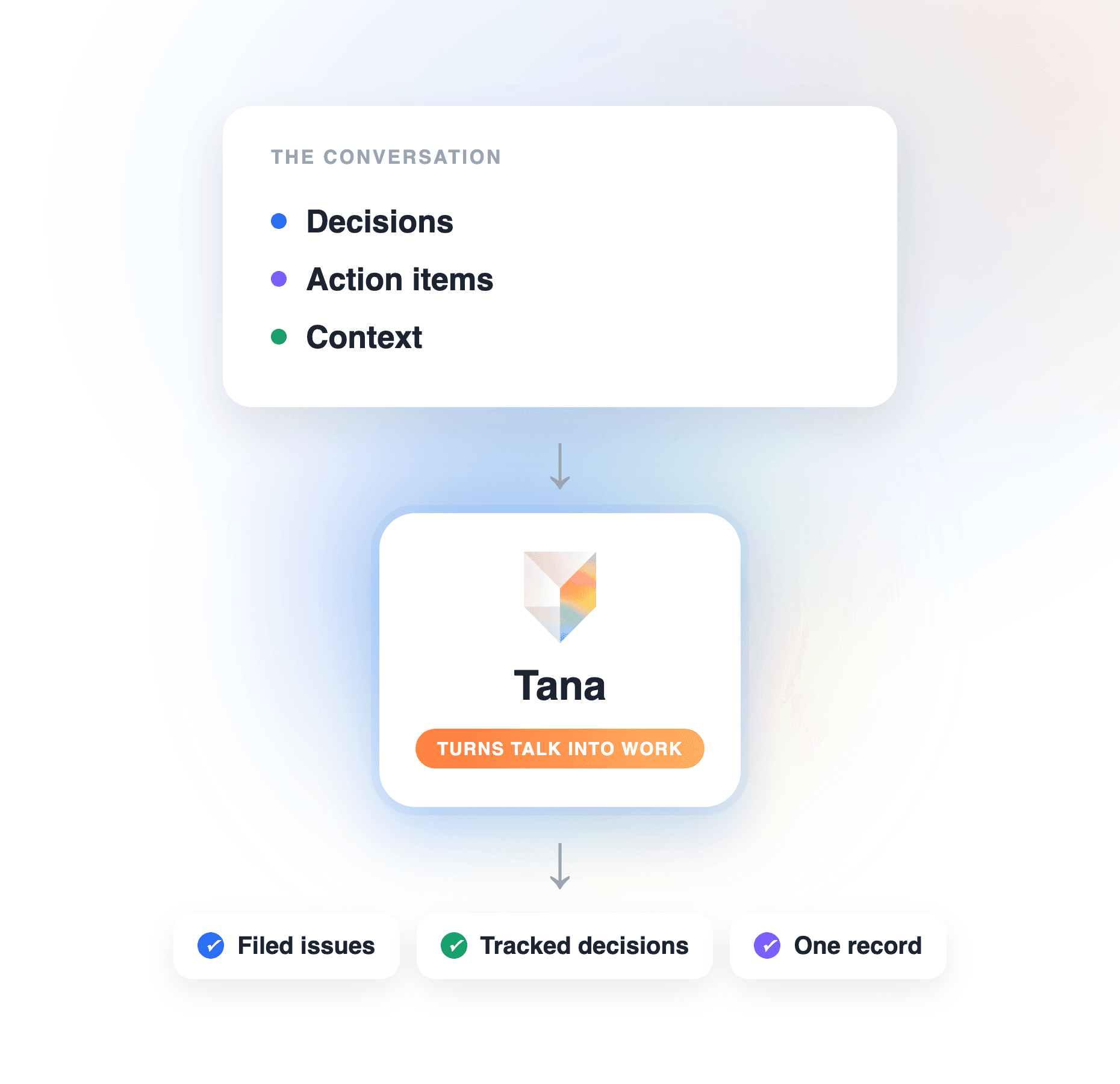
- Tana closes both gaps. As you talk, its agents turn the conversation into filed work, issues in Linear, GitHub, or Jira with screen-share screenshots, drafted PRDs, follow-up Slack messages, each a proposal you approve, and it updates the record you already have instead of adding another summary.
- Judge a meeting tool by what happens after extraction, not by how good the summary reads.
AI notetakers are not failing at notes. The transcripts are accurate, the summaries are readable, and most tools now pull out action items with owners attached. The failure shows up a week later: the bug discussed on Tuesday is still not in the tracker, the summary nobody reopened has the decision in it, and the third call this month covers the same ground because nothing carried over. This guide explains why that happens, what a notetaker structurally cannot do about it, and what closing the gap looks like. For ranked comparisons, see Best agentic meeting platforms 2026 and Best AI meeting assistant alternatives for teams 2026.
What AI notetakers actually do well
Credit where it is due, and it is a narrow strip. Notetakers capture the call, transcribe it with speaker labels, summarize it, and extract action items. Several capture without a bot now, and some push output onward after the call: Fireflies can convert action items into Jira or Linear issues once the meeting ends, and most tools sync a summary to a CRM or Slack. If a clean record of what was said is the deliverable, any of them will produce it.
That strip used to be the hard part. In 2026 it is the commodity part, which is why the tools are hard to tell apart on capture quality alone. The differences that matter start where the notetaker stops: at the moment the summary exists and the work does not.
The first limit: extracted is not done
An action item is a description of work, not the work. When a notetaker hands you "Fix the onboarding drop-off, owner: Sara," someone still has to open the tracker, write the issue, find the screenshot of the broken screen, link the related ticket, and write the Slack message telling the team it is filed. The notetaker compressed the meeting; the follow-through is intact and yours.
Where a notetaker does push into a tracker, the push is a bare line item, fired after the call: a title, an owner, a link back to the recording. The context that makes an issue actionable, what was on screen when the bug appeared, the spec the discussion implied, the doc it affects, is not part of the sync. And because the push is automatic and unreviewed, teams end up choosing between two kinds of noise: a tracker filling with unvetted stubs, or the sync turned off and the follow-through back on a person.
Tana treats the meeting as the place the work gets made, not summarized. During the call, its AI agents turn the conversation into the work itself: a sprint review can produce filed Linear, GitHub, or Jira issues with screen-share screenshots and written descriptions attached, a drafted PRD, and a follow-up Slack message, before the call ends. Each one is prepared by a skill and lands as a proposal you review before anything is written, so the tracker gets real issues, not stubs, and nothing is filed behind your back. The output reaches the tools your team already runs on through integrations, including GitHub, Linear, Jira, Slack, and HubSpot, and an MCP server connects Tana to anything else that speaks it.
The second limit: every meeting is its own record
A notetaker produces one summary per call, and then the next call gets its own. Nothing connects them. The decision made in March lives in March's summary; when the same topic comes up in June, the tool summarizes it fresh, with no idea the ground was covered. Recall, where it exists, is search over a pile of transcripts: you can find the meeting where something was said, if you remember to look and know what to search for.
This is why meeting knowledge goes stale even when capture is flawless. The record of a project is not one document that stays current; it is a scatter of per-meeting summaries, each accurate on the day it was written and collectively misleading a month later. The team's real state lives in nobody's tool, so it lives in people's heads, and it leaves when they do.
Tana keeps one record instead. Every meeting feeds connected context, so the decision, the person who made it, and the project it affects link to each other rather than sitting in separate summaries. When a project doc already exists, extraction updates it rather than creating a parallel one, and re-running extraction updates the existing outcomes instead of duplicating them. The record you had yesterday is the record that gets more current today. Ask the chat "what did we decide about onboarding, and why" and the answer comes grounded in the meeting where it was decided.
The third limit: the notetaker arrives with the meeting and leaves with it
A notetaker knows nothing before the call starts and forgets its context after the summary ships. It cannot brief you on the account you are about to walk into, and it cannot carry what was captured into the work that happens between meetings.
A tool that holds the team's context can do both. In Tana, you can build an agent that preps you before a meeting by pulling together the people, the open issues, and the last decisions on the topic, and the same context is available after the call to whatever picks the work up. That includes coding agents: a captured bug can hand off to Claude Code, Cursor, Codex, GitHub Copilot, or Lovable with the meeting context attached, so the fix starts from what was actually discussed.
What driving action actually requires
Put the limits together and the requirements fall out. A meeting tool drives action when it:
- Produces the work, not a description of it: filed issues with context, drafted documents, prepared follow-ups, not a checklist.
- Acts while you talk: the issue exists before the call ends, with the screen-share moment attached, instead of joining a post-call cleanup queue.
- Keeps a human in the loop: every change is a proposal you approve, so speed does not cost you control of your own tracker.
- Maintains one record that stays current: new meetings update what exists and de-duplicate, instead of stacking another summary on the pile.
- Works before and between meetings: prep going in, handoff coming out.
Notetakers meet none of these by design, because they were built for a different job: producing a faithful record of what was said. That job is done, and done well, across the category. The open problem is the one Tana was built for. If all you need is the record, a notetaker is the simpler purchase. If the point of the meeting was the work it was supposed to produce, the record was never the deliverable. For the tools ranked on this, see AI meeting tools that drive follow-through.
All product details were verified in July 2026.
Frequently asked questions
Why are AI notetakers not enough for getting work done?
Because they end at extraction. A notetaker gives you an accurate summary and a list of action items, but the action items are descriptions of work, and carrying them out, filing the issue, writing the spec, sending the follow-up, remains yours. Each meeting also becomes its own disconnected record, so context fragments over time. Tana closes the gap by doing the work during the call: its agents file issues with screenshots, draft PRDs, and prepare follow-ups as proposals you approve, and every outcome lands in one connected record that stays current.
Do AI notetakers create action items automatically?
Yes, and they have for a while. Extracting action items with owners is standard across Otter, Fireflies, Fathom, and the rest, and some can push those items into a tracker after the call as line items with a link to the recording. What no notetaker does is produce the work in reviewable form: a full issue with the screen-share screenshot and description, a drafted document, a prepared message. Tana's agents produce exactly that, during the meeting, and each one is a proposal you approve before it is written anywhere.
Why do meeting summaries go unused?
Because a summary is a record, and records only pay off when someone reopens them. Most never are: the moment the meeting ends, attention moves to the next one, and the summary joins a pile of per-meeting documents nothing connects. The fix is not a better summary. It is a tool where the meeting's outcomes become live work and updates to documents the team already uses, which is what Tana's meeting extraction does: it prefers updating the existing project record over creating another parallel summary.
Can an AI notetaker update my project tracker?
Some can push extracted action items into tools like Jira or Linear after the call, as bare items with a title, an owner, and a recording link. That is a sync, not filed work: the context stays in the transcript, and the push is unreviewed. Tana files real issues into Linear, GitHub, or Jira during the call, with screen-share screenshots and written descriptions, each as a proposal you approve, so the tracker gets work you would stand behind.
What should teams use instead of an AI notetaker?
Keep the capture, add the follow-through. Tana captures its own calls and external Zoom, Teams, or Meet calls bot-free from the desktop app, so you lose nothing on the recording side, and then its agents turn the conversation into filed, approved work on one connected record. For a ranked comparison of the options, see Best AI meeting assistant alternatives for teams 2026.
Explore further