





TL;DR
- Every mainstream tool measures meeting load: hours, counts, attendees, after-hours time, recurrence. Almost none measures outcome. Zoom's analytics cover usage and call quality. Microsoft Viva Insights adds multitasking and redundant attendance. None of them tells you whether a decision was made.
- The metrics worth tracking are decision-shaped, and the only named framework behind them is Bain's: per meeting series, count the decisions made, delayed and revisited.
- Two large independent surveys agree that the failure is at the close of the meeting, not during it: 54% of knowledge workers frequently leave meetings unclear on next steps or ownership (Atlassian), and 55% report unclear next steps after meetings (Microsoft).
- The reason the outcome metrics are hard is upstream of any dashboard: meetings leave prose, and you cannot count prose. Tana fixes that at the source. Every decision and action item leaves the meeting as a typed record with an owner, a state and a date, so the things worth measuring exist as data in the first place, and the answer is a question away rather than a report you build.
Most meeting-metrics articles hand you a list of things your calendar can already count, then imply that counting them will fix something. Two problems with that. The first is that meeting load is the easy measurement and the least actionable one. The second is more uncomfortable: the research base for meeting effectiveness is thin. A 2023 CIPD evidence review found that of 30 studies identified, 25 were graded low trustworthiness and only five were controlled or longitudinal. So this list is short on confident benchmarks and long on things you can actually observe about your own team.
Why meeting load is the wrong headline metric
Load metrics are seductive because they are free. Your calendar already knows them. But a team can cut meeting hours by 20% and be no better at shipping, because the hours were never the problem. The problem is what the hours produced.
There is one load figure worth keeping as a guardrail. Slack's Workforce Index, surveying more than 10,000 desk workers in December 2023, found that more than two hours a day in meetings is the point at which a majority feel overburdened, and that people who say they spend too much time in meetings are more than twice as likely to say they lack focus time. Treat two hours a day as a ceiling, not a target, and move your attention to the outcome metrics below.
The 10 metrics
| # | Metric | What it tells you | Where the data comes from |
|---|---|---|---|
| 1 | Decisions made per series | Whether the forum decides or discusses | Your record of the meeting |
| 2 | Decisions delayed | Where the forum stalls | Your record of the meeting |
| 3 | Decisions revisited | Whether decisions stick | Your record of the meeting |
| 4 | Next-steps clarity at the close | The single most common failure point | 30-second exit check |
| 5 | Meetings that end by booking another meeting | Discussion masquerading as progress | Calendar plus record |
| 6 | Action items with a named owner | Whether work is owned or floating | Your record of the meeting |
| 7 | Necessary-attendance rate | Whether the invite list is honest | Anonymous attendee survey |
| 8 | Attendee-rated effectiveness | The only validated subjective measure | Anonymous attendee survey |
| 9 | Recurring meeting load | The load that compounds unnoticed | Viva Insights or your calendar |
| 10 | Multitasking during meetings | Whether people are actually present | Viva Insights |
1. Decisions made per meeting series
Count how many decisions a recurring forum actually closes in a month. This is the metric Bain built its decision-effectiveness practice on, and it recommends tracking it at the level of the decision forum rather than the individual, alongside how often decisions escalate to a higher decision maker. It is the most useful number on this list because it converts a vague feeling ("that meeting goes nowhere") into something a team can look at together.
2. Decisions delayed
The companion metric, and the more diagnostic one. A forum that decides three things and defers nine has a structural problem: the wrong people, missing information, or no clear owner. McKinsey's 2019 survey of 1,259 executives found 61% said at least half the time spent making decisions was ineffective, and that managers spend around 37% of their time on decisions with 58% of that time used ineffectively. Counting deferrals is how you find where that goes.
3. Decisions revisited
How often does a decision come back? Bain names this explicitly as a forum-level metric, and it is the one most teams feel but never count. A decision that gets re-litigated three sprints later usually means the original decision was never recorded anywhere findable, so nobody could point at it. That makes this metric a proxy for the quality of your record, not just your decisiveness.
4. Next-steps clarity at the close
Ask one question at the end of the meeting: does everyone know what happens next and who owns it? This is the highest-value item on the list because two large independent samples agree it is where meetings fail. Atlassian's 2024 survey of 5,000 knowledge workers found 54% frequently leave meetings unclear on next steps or who owns which task. Microsoft's 2023 Work Trend Index, surveying 31,000 people across 31 markets, found 55% report unclear next steps after meetings. When two studies with different methods land within a point of each other, that is as close to a reliable benchmark as this field offers.
5. Meetings that end by scheduling another meeting
The same Atlassian survey found 77% regularly attend meetings that end by scheduling another meeting. Tracked per series, this separates forums that produce outcomes from forums that produce calendar entries. It is easy to count and hard to argue with.
6. Action items with a named owner
Not the count of action items. The share of them that leave the meeting attached to a person. An unowned action item is a note, and it behaves like one.
Worth saying plainly, because you will see the opposite claimed everywhere: there is no credible published measurement of what fraction of meeting action items get completed. The widely quoted figure of 44% has no traceable primary source, and neither do the 80% and 73% variants. Even the largest published meeting-telemetry report does not measure it. Track your own completion rate; do not benchmark against a number somebody invented.
7. Necessary-attendance rate
What share of attendees needed to be there? A 2022 survey of 632 US employees led by Steven Rogelberg at UNC Charlotte found people averaged 17.7 meetings a week but judged only 11.8 critical to attend, wanted to decline 31% of invitations and actually declined 14%. The gap between wanting to decline and declining is a culture problem, and 78% of managers in that study had never discussed declining meetings with their reports. Measuring it makes the conversation possible.
8. Attendee-rated effectiveness
The one subjective measure with real research behind it. Leach, Rogelberg, Warr and Burnfield's 2009 studies found that agenda use and attendee involvement predict perceived meeting effectiveness, with involvement as the key mediator. Two rules make the measurement trustworthy: survey attendees, not the organizer, and do it anonymously. Rogelberg's later work found leaders consistently rate meetings they run far more positively than the people attending them do, so an organizer's self-assessment is the least reliable input available.
9. Recurring meeting load
Recurring meetings are where load accumulates without anyone deciding to add it. Microsoft Viva Insights measures this directly as recurring meeting hours, split by size and duration, and it also reports redundant meeting hours, meaning time in meetings where both a person's manager and their skip-level manager were present. Review the recurring set quarterly rather than watching a weekly number. Shopify cancelled 12,000 recurring meetings with three or more attendees in one sweep in January 2023, projecting 322,000 hours saved across the year.
10. Multitasking during meetings
Viva Insights defines multitasking hours as time spent sending or reading email or chats during a meeting. It is the closest thing any platform offers to an engagement measure, and it is honest: if half the room is answering email, the meeting is not doing what its invite claims. Treat it as a signal about the meeting, never about the person.
Two metrics not to track
Anything at the individual level. This is not a soft warning. Microsoft launched Productivity Score in October 2020 exposing per-user meeting and communication metrics, and withdrew the individual-level view within five weeks after it was widely characterized as workplace surveillance, aggregating everything to organization level instead. A 2023 meta-analysis of electronic performance monitoring covering 94 samples and 23,461 participants found no evidence that monitoring improves performance, and found it associated with increased stress regardless of how it was configured. Harvard's Ethan Bernstein documented the deeper mechanism in a field experiment: observability can make people conceal work, and a modest increase in group-level privacy improved performance.
Anything you are about to set as a target. Marilyn Strathern's 1997 formulation of Goodhart's law is the one to keep in mind: when a measure becomes a target, it ceases to be a good measure. Set "decisions made" as an OKR and you will get decisions, some of which should have been deferrals.
Measuring meetings is a capture problem, not a reporting problem
Here is the part most articles skip. Metrics one through six do not exist in any tool you currently own, and the reason is not that the dashboards are lazy. It is that meeting outcomes have never been data. Your calendar knows how many hours you sat in meetings, so hours are what gets measured. No system knows what you decided, because the decision left the room as a sentence inside a summary, and a sentence cannot be counted, filtered or tracked over time.
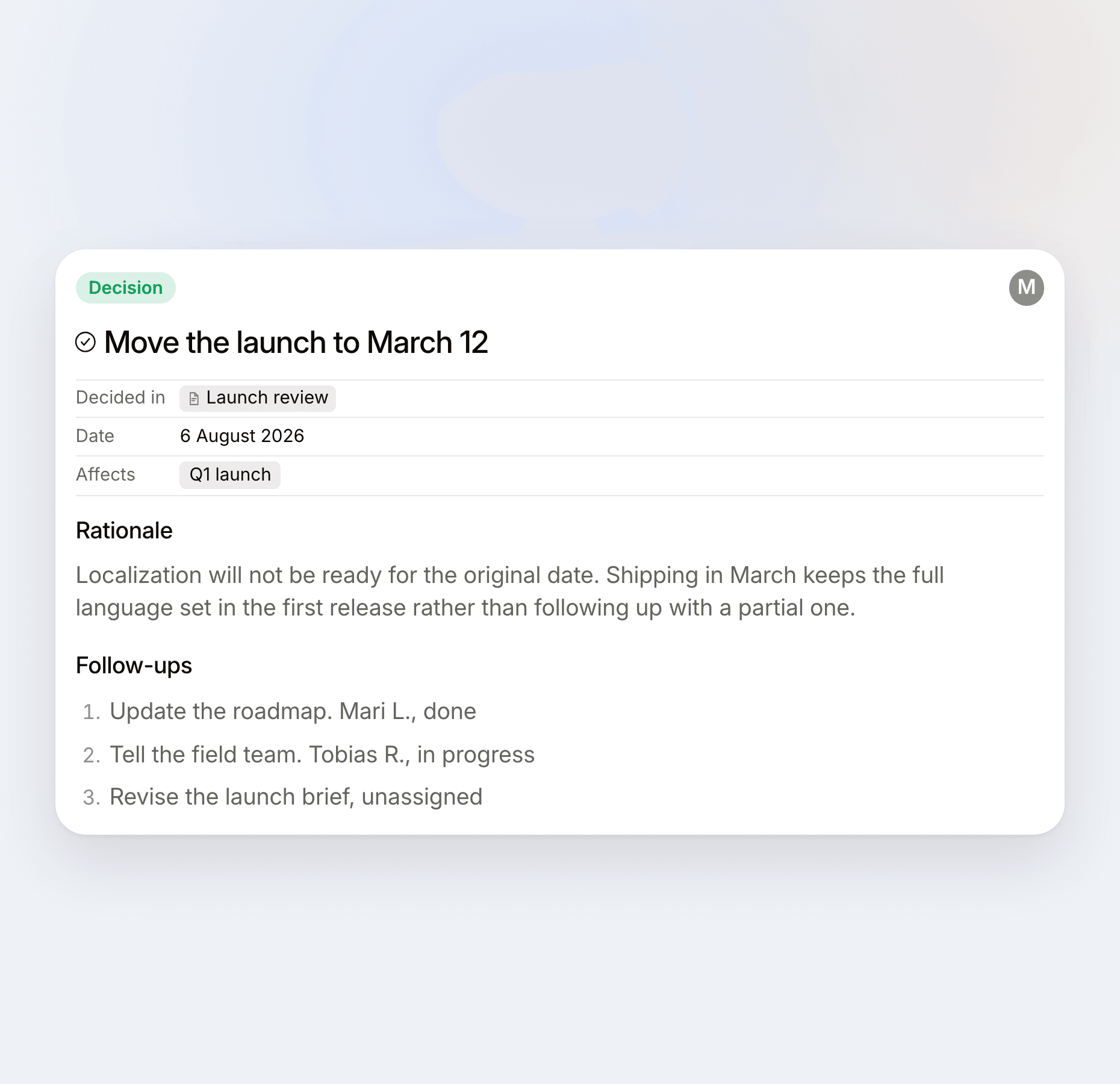
Fix that upstream and the reporting problem mostly dissolves. This is what Tana is doing during the meeting: each decision, action item, bug or open question becomes a typed record with a state, an owner and a date, filed through agents as proposals you approve. Once the outcomes are records rather than prose, the questions you actually care about are answerable directly. Open the Decision type page and every decision your team has made is listed with its Active, Completed and Later tabs. Filter the tasks view by assignee, type or space and bookmark it. Or ask chat which decisions in a product area are still open, and get the answer with a link to the meeting each one came from.
That last part is the real upgrade over a dashboard. A chart answers the question you configured it for last quarter. A structured record answers the question you have now, including the ones nobody thought to build a chart for, and it cites the conversation behind each answer so a surprising number is something you can go and read rather than something you have to trust.
It also matters that the record stays current. When Tana extracts an outcome it first checks whether a record for the same thing already exists and updates that one instead of creating a duplicate, so a recurring meeting leaves one live record rather than twelve summaries. A decision you can point at is what makes "was this revisited?" answerable at all, and it is why decision metrics are tractable here and nowhere else.
How to start
Pick two, not ten. Most teams should start with next-steps clarity and decisions revisited, because they are the two with the clearest link to whether the meeting was worth holding.
Run them for one recurring meeting for six weeks. Log the decisions and their owners in the same place every time. Ask attendees one anonymous question at the close. Then look at the six weeks together rather than reacting weekly, because week-to-week variation in a small sample tells you nothing. If the decisions-revisited count is high, the fix is usually the record rather than the meeting.
Frequently asked questions
What are the most important meeting metrics to track?
Decisions made, decisions delayed and decisions revisited, per recurring meeting series, plus whether people leave knowing the next steps and who owns them. Those four say more about whether a meeting is worth holding than any measure of hours or attendance. Load metrics like meeting hours are worth a glance as a guardrail, with roughly two hours a day being the point where most people feel overburdened, but they do not tell you whether anything happened. Tana is built to make the first four measurable by filing each decision and action item as a typed record with an owner and a state.
Can Zoom or Microsoft Teams measure meeting effectiveness?
Not really. Zoom's analytics report usage and call quality: meeting counts, participants, minutes, devices, connection scores. Microsoft Viva Insights goes further with recurring meeting hours, conflicting hours, after-hours meeting time, redundant manager attendance and multitasking during meetings. All of that measures load and behaviour, not outcome. Neither platform can tell you how many decisions a meeting produced, because neither captures the decision as data. That requires the meeting's outcomes to be filed as structured records, which is what Tana does.
How do you measure whether a meeting was productive?
Ask the attendees, anonymously, and count what the meeting produced. The research supports attendee-rated effectiveness as a valid measure, with agenda use and attendee involvement as the main predictors, and it warns against trusting the organizer's own rating, since leaders rate their own meetings much more positively than participants do. Pair the survey with a count of decisions closed and action items that left with an owner. Tana gives you the second half automatically, since each outcome becomes an owned, stated record rather than a line in a summary.
What percentage of meeting action items are never completed?
Nobody credibly knows, and the numbers you will see quoted are not real. The commonly repeated 44% figure has no traceable primary source, and the same is true of the 80% and 73% variants. What is well supported is the upstream condition: 54% of knowledge workers frequently leave meetings unclear on next steps or ownership, and 55% report unclear next steps after meetings. Measure your own completion rate against your own baseline. Tana makes that possible by giving every action item an owner and a state at the moment it is captured.
Should we track meeting metrics per person?
No. Individual-level meeting metrics reliably backfire. Microsoft withdrew the per-user view of Productivity Score within weeks of launching it after it was characterized as surveillance, and a meta-analysis of 94 studies covering 23,461 participants found no evidence that electronic performance monitoring improves performance while consistently associating it with more stress. Measure the meeting series, not the attendee. Tana's records are organized around the work rather than the worker, and AI in Tana only ever reads what the person invoking it can already access.
How do I track decisions across recurring meetings?
Record each decision as its own item with a date, an owner and a status, in the same place every time, and link it to the project it affects. That is the whole method, and it fails in practice because writing it up is nobody's job. Tana does it from the conversation: a decision becomes a typed record with its rationale, filed as a proposal you approve, and if that decision already exists it updates the record rather than creating a second one. Asking chat what was decided returns the answer with a link to the meeting it came from. See How to keep meeting action items from getting lost.
Explore further