


TL;DR
- Personal knowledge management (PKM) is the practice of capturing, organizing, connecting, retrieving, and sharing what you know, so a thought you had once is still useful months later.
- Popular methods like PARA, Zettelkasten, and the second brain give you a way to file notes. They do not fix the real problem: keeping the system current.
- Most PKM systems fail on the maintenance tax. You capture faster than you organize, notes never get revisited, and the archive quietly rots into a place things go to be forgotten.
- AI changes the shape of PKM: instead of a filing system you tend yourself, the system can build and connect itself from your work. A layer like Tana captures context as you work, links it automatically, and scales from you to your team and to your AI agents.
Most advice about personal knowledge management, or PKM, is really advice about filing. Pick a folder structure, tag consistently, review weekly. The trouble is that filing is the part humans are worst at and least motivated to keep up. You save an article, jot a meeting note, capture an idea, and then never look at any of it again. This guide explains what PKM actually is, the methods people reach for, why so many systems go stale, and how AI shifts the job from maintaining a system to working while the system maintains itself, which is the part a layer like Tana is built to handle.
What is personal knowledge management?
Personal knowledge management is the practice of capturing what you learn and encounter, organizing it so you can find it, connecting related pieces, retrieving the right thing when you need it, and sharing it when it helps someone else. It is the system, formal or scribbled, that turns fleeting inputs into knowledge you can act on later.
Five activities sit at its core:
- Capture: getting a thought, quote, link, or decision out of your head and into a trusted place before it evaporates.
- Organize: giving what you captured enough structure that future-you can locate it.
- Connect: relating a new note to what you already know, so ideas compound instead of piling up.
- Retrieve: surfacing the right piece at the moment you need it, not three days later.
- Share: turning private notes into something a colleague or an AI agent can use.
Do these well and your past thinking becomes an asset. Do them poorly, which is the common case, and you have a growing pile of notes you never open.
The popular PKM methods
Most PKM systems are built on one of a few well-known methods. They are worth knowing, and none of them is the point.
- PARA organizes everything into Projects, Areas, Resources, and Archives. It is a clean way to sort notes by how actionable they are, popularized by Tiago Forte.
- Zettelkasten is a network of small, atomic notes that link to each other, so knowledge forms a web rather than a hierarchy. It rewards patient, consistent linking.
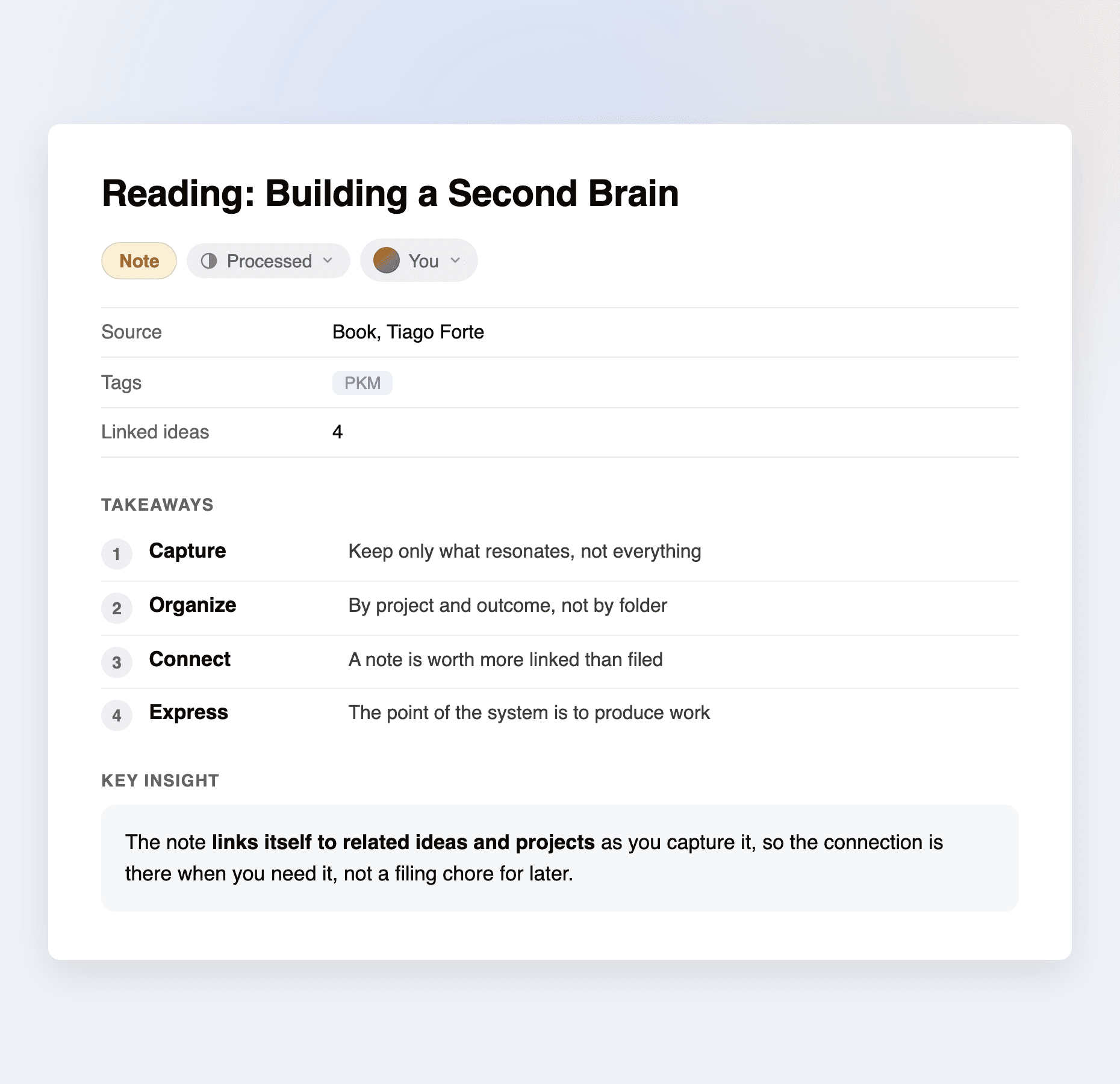
- The second brain is the broader idea, also from Forte, that you offload what you know into an external system you can trust, freeing your mind to think rather than remember.
Each is a sound way to think about structure. But every one of them assumes you will keep doing the filing and the linking yourself, week after week. That assumption is where PKM usually breaks. For a comparison of the apps that put these methods into practice, see the best personal knowledge management tools.
Why most PKM systems fail
Most PKM systems fail for one reason: the maintenance tax. Capturing is easy and satisfying, so you do a lot of it. Organizing, linking, and revisiting are work, so you do less and less of it, and the gap compounds.
Three failure modes show up again and again:
- The capture-organize gap. You save far faster than you file. Within weeks the inbox of unsorted notes is larger than the sorted archive, and sorting it feels like a chore you keep deferring.
- Notes that never get revisited. A note you never reopen did no work. Most PKM archives are write-only: things go in, almost nothing comes back out at the moment it would have helped.
- The archive goes stale. Even the notes you did file describe how things were when you wrote them. The decision changed, the project moved, the contact left, and nothing in your system knows that. Stale knowledge is worse than none, because you trust it.
The uncomfortable conclusion is that the method is rarely the problem. PARA versus Zettelkasten barely matters if neither survives contact with a busy month. The problem is that the system depends on your discipline to stay alive, and discipline is exactly what runs out.
How AI changes personal knowledge management
AI changes PKM by moving the work you kept failing at off your plate. The old model asked you to be the filing clerk: capture, tag, link, and review, forever. The new model lets the system do most of that from the work you are already doing.
Concretely, AI shifts three things:
- Capture becomes ambient. Instead of stopping to write a note, your meetings, messages, and documents can be turned into structured knowledge as they happen, so the record exists without a separate filing step.
- Connection becomes automatic. Rather than linking notes yourself, AI can relate a new decision to the project, people, and prior calls it touches, so the web of knowledge forms on its own.
- Retrieval becomes a question. Instead of remembering where you filed something, you ask in plain language and get the answer, grounded in where it actually came from.
The catch is that this only works if the AI is drawing on a current, connected source rather than the same stale pile of notes. AI on top of a rotting archive just retrieves rot faster. The value is in a knowledge layer that stays current because it is fed by your work, which is a different kind of tool than a folder of notes.
From a personal system to a team
Here is the question most PKM advice skips: a personal system does not compound with anyone else's. Your notes live in your app, in your structure, readable only by you. The moment the knowledge matters to a colleague, or to an AI agent working on the team's behalf, a private second brain becomes a bottleneck.
Teams do not need many disconnected personal systems. They need one shared context that everyone, and every agent, can draw on, with access controlled per item so people see what they should. That is a genuinely different problem from personal PKM, and it is the reason a note-taking app that is perfect for one person rarely scales to a team. For the team version of this question, see best knowledge graph tools for teams 2026.
Where Tana fits
Tana approaches PKM from the other end: instead of a system you maintain, it is a shared context that builds itself from your work and connects automatically. What that looks like in practice:
- Knowledge captures itself as you work. Your meetings are recorded and turned into structured items without a bot in the call, including external Zoom, Teams, and Meet calls in the background. See meetings. The note exists because the work happened, not because you remembered to write it.
- Everything is connected and typed, not filed loose. People, projects, decisions, and meetings are stored as typed items with relationships between them, so a decision already knows which project and which call it belongs to. Re-running extraction updates the existing item and de-duplicates instead of spawning a second copy, so the record stays current rather than going stale.
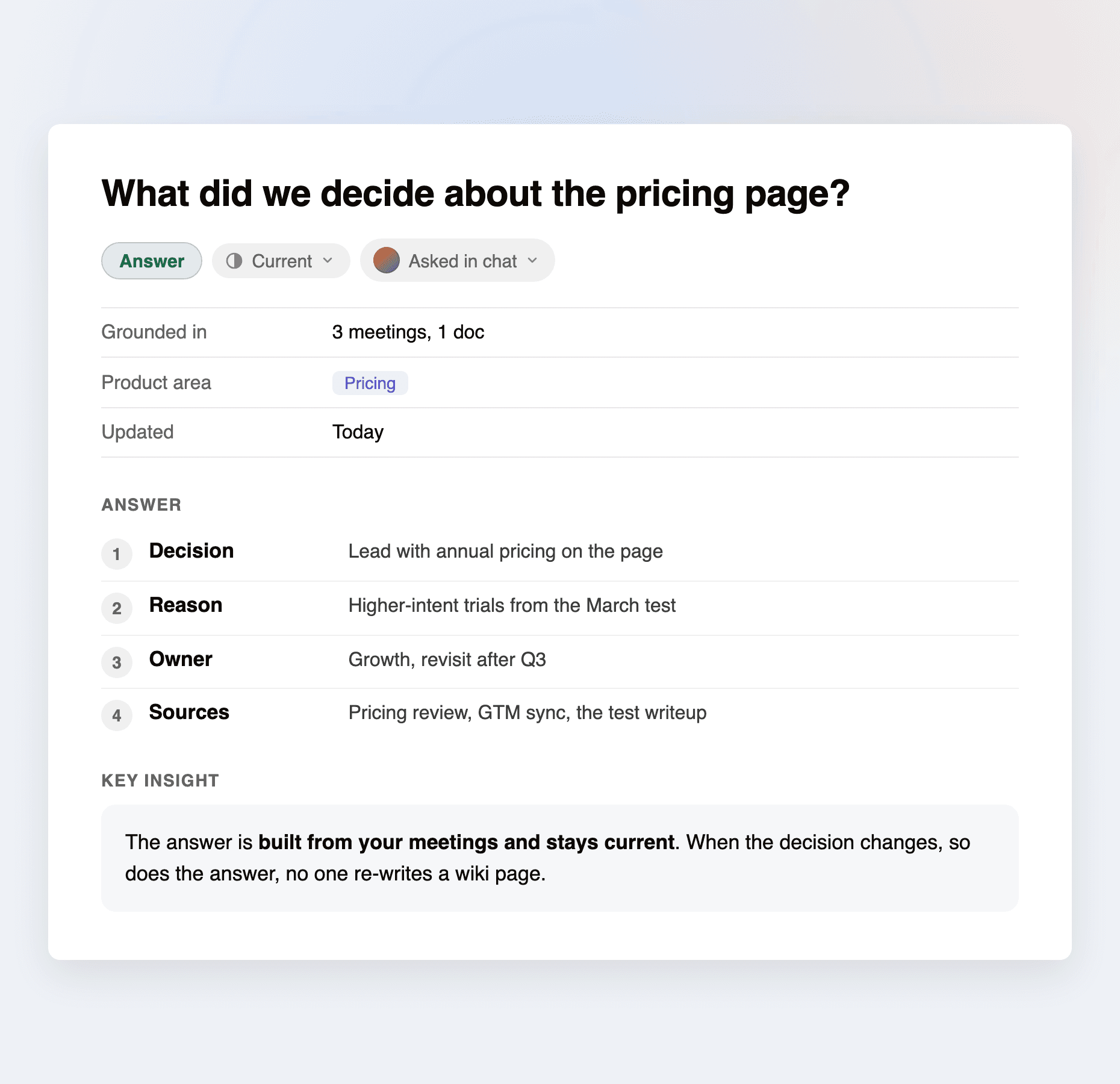
- Retrieval is a question, grounded in the source. Ask chat "what did we decide about pricing, and why" and you get the answer tied to the meeting it came from, not a search you have to interpret.
- It scales from you to your team to your agents. The same context is access-controlled and shared, and AI agents can turn conversations and inputs into filed work as proposals you approve, so a human stays in the loop. Because Tana exposes a Model Context Protocol server, other AI tools can read and write that context too, which is what turns a personal knowledge base into a source your agents rely on. For more on giving agents a dependable context layer, see what is context engineering for AI agents.
The shift is from a second brain you keep alive yourself to a context that stays current because your work keeps it that way, and that is usable by more than one person.
Frequently asked questions
What is personal knowledge management in simple terms?
Personal knowledge management is how you capture, organize, connect, retrieve, and share what you know, so a thought or a decision stays useful long after you had it. In practice it is the system that keeps your notes, ideas, and references from disappearing into a pile you never reopen. The hard part is not choosing a method but keeping the system current, which is why AI-backed tools like Tana build and connect the knowledge from your work instead of asking you to file it yourself.
What is the best PKM method: PARA, Zettelkasten, or the second brain?
There is no single best method, because the method is rarely what makes a PKM system succeed or fail. PARA sorts notes by how actionable they are, Zettelkasten links atomic notes into a web, and the second brain is the general idea of offloading what you know into a trusted external system. All three work only as long as you keep doing the filing and linking yourself. Tana takes the pressure off that discipline by capturing context from your meetings and work and connecting it automatically, so the structure forms without a weekly upkeep ritual.
Why do most PKM systems fail?
Most PKM systems fail because of the maintenance tax: you capture far faster than you organize, the notes you save never get revisited, and even filed notes go stale as the underlying facts change. The method is seldom the culprit. The system dies when it depends on your discipline to stay alive and that discipline runs out. Tana addresses this directly by keeping knowledge current as work happens, updating existing items rather than leaving a stale copy, so the archive does not rot.
How is AI changing personal knowledge management?
AI changes PKM by moving capture, connection, and retrieval off your plate. Instead of writing and filing notes, your meetings and documents can be turned into structured knowledge as they happen; instead of linking notes yourself, AI relates new information to what it touches; and instead of remembering where you filed something, you ask a question and get the answer. This only helps if the AI draws on a current, connected source rather than a stale pile, which is why Tana focuses on a knowledge layer that stays current because your work feeds it.
Can a personal knowledge management system work for a whole team?
A personal system rarely scales to a team, because private notes do not compound with anyone else's and become a bottleneck the moment the knowledge matters to a colleague or an AI agent. Teams need one shared context, access-controlled per item, that everyone and every agent can draw on, which is a different problem from personal PKM. Tana is built for exactly that: it captures shared context from the team's work, controls access per item, and serves it to people and to agents through a Model Context Protocol server. See best knowledge graph tools for teams 2026 for the team-scale comparison.
Explore further