


TL;DR
- An AI second brain is a personal knowledge system that captures what you work on, connects it, and answers questions in your own words, so you can find and reuse what you know instead of remembering it.
- The "second brain" idea (popularized by Tiago Forte) is a place outside your head to store notes and ideas. The "AI" part adds retrieval you can talk to, memory that persists, and the ability to act, not just store.
- It differs from a plain notes app (which you fill and organize yourself) and from a raw chatbot (which forgets everything between chats). A real AI second brain has to remember your work and stay current.
- Most second brains fail on upkeep: you file things and never revisit them, and the notes go stale. The fix is a system that builds itself from your work rather than one more thing to maintain. That is what Tana is built to be, for you and your team.
Most people who have tried to build a "second brain" have the same story: a burst of enthusiasm, a folder structure, a few hundred notes, and then silence. The system needed constant feeding, and feeding it was work. An AI second brain changes the deal. Instead of a filing cabinet you maintain, it is a system that captures from what you already do, connects it, and answers back when you ask. This guide defines what an AI second brain is, how it differs from a notes app and from a chatbot with no memory, the components it needs, why most attempts fail, and where a tool like Tana fits, one that fills and updates itself from your work rather than waiting for you to tend it.
What is an AI second brain?
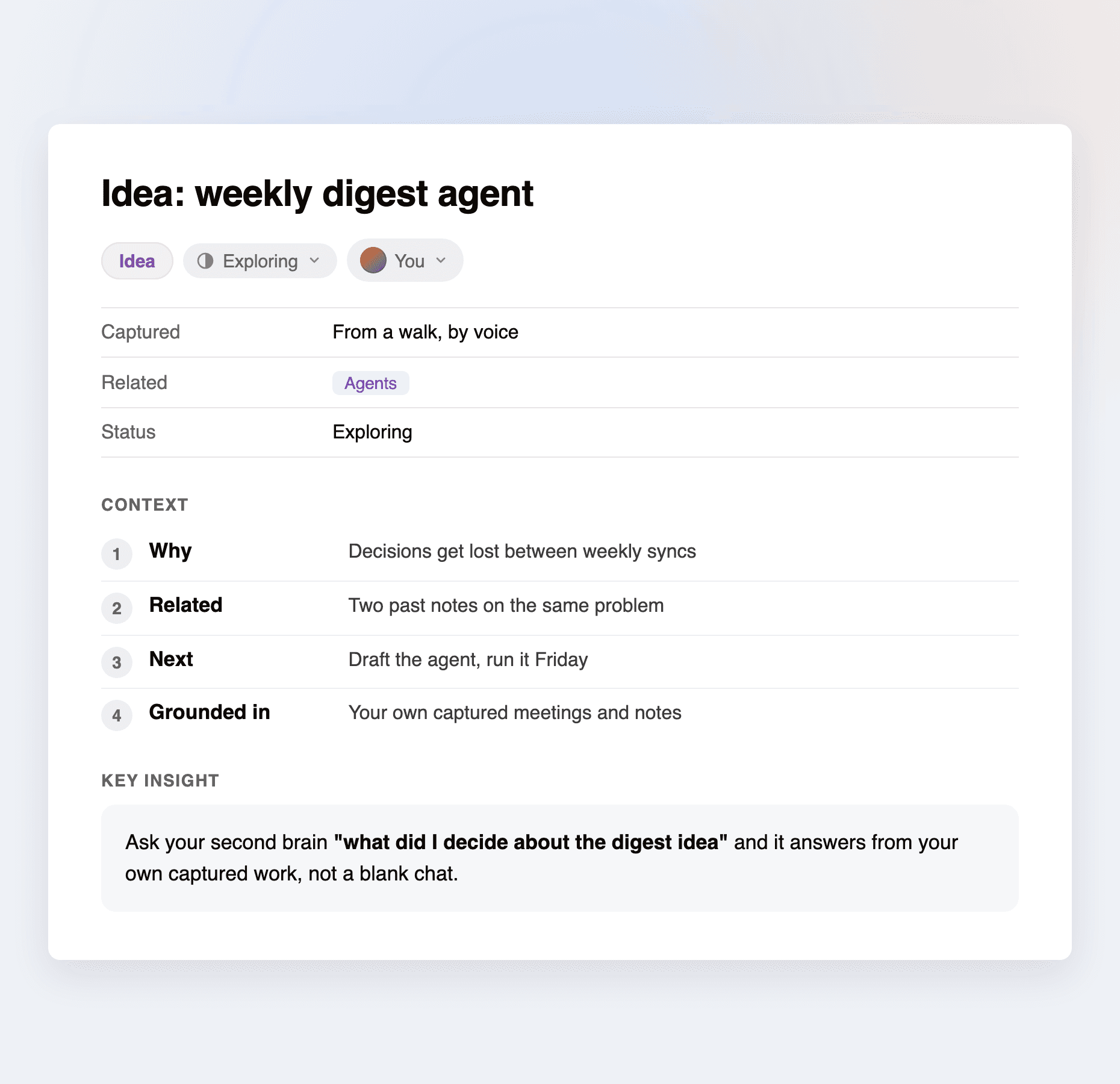
An AI second brain is a personal knowledge system that captures your information, connects it, and lets you retrieve and act on it through AI, so it works like an extension of your memory instead of a static archive. The classic "second brain," a term popularized by productivity writer Tiago Forte and the personal knowledge management (PKM) tradition, is a trusted place outside your head to store notes, ideas, and references so you can think with them later. The AI part adds three things a plain store never had: you can ask it questions in natural language and get an answer, it remembers your work over time, and it can turn what it finds into action.
So the shift is from a place you put things to a system that works with what you put in it. You are no longer the search engine, the librarian, and the archivist for your own notes. You ask, and it retrieves. You capture, and it connects.
How it differs from a notes app and a chatbot
An AI second brain sits between two tools people already know, and it is not either of them.
- A plain notes app (Apple Notes, a folder of Markdown, a basic wiki) stores what you type and leaves the rest to you. You do the filing, the linking, and the remembering to come back. It has no memory of what matters and cannot answer a question, only show you a document if you find it.
- A raw chatbot answers questions well but starts each conversation empty. It does not know what you decided last month, who owns which project, or what happened in yesterday's call, unless you paste it in every time. Its "memory" is the current chat window.
An AI second brain is the combination: the persistent, connected store of a notes app plus the ability to ask and act of a chatbot, grounded in your own information. The store gives the AI something true to work from; the AI makes the store worth keeping. Miss either half and you are back to a filing cabinet or a goldfish.
The components of an AI second brain
Whatever tool you use, a working AI second brain needs four things:
- Capture. Getting information in without much effort. The best systems capture from the work itself, your meetings, messages, and documents, so filling it is not a separate chore.
- Connect and structure. Turning loose notes into connected, typed information: people, projects, decisions, and meetings that link to each other, so context accumulates instead of piling up.
- Retrieve. Asking a question in plain language and getting an answer grounded in your own information, with the source, not a generic guess from the model's training.
- Act. Turning what you find into finished work: a task created, a document drafted, an update filed, rather than a note you still have to act on yourself.
The first two are where a notes app stops. The last two are where a chatbot stops. An AI second brain has to do all four, and do them on information that stays current. For how the tools that aim at this compare, see the best second brain apps.
Why most second brains fail
Most second brains fail for one reason: upkeep. You capture eagerly for a few weeks, then the filing falls behind, the structure rots, and you stop trusting what is in there, so you stop looking. The notes that survive are frozen at the moment you wrote them, and the world moved on. A second brain you have to maintain by hand competes with your actual work, and your actual work wins.
The deeper problem is that the value shows up later, when you revisit, and revisiting is exactly what nobody does. A system that only pays off if you diligently tend and reread it is a system designed to be abandoned. The fix is not more discipline. It is a system that fills and updates itself from the work you were already doing, so the store stays current without you being its librarian.
Why memory and grounding matter for the AI part
The AI in an AI second brain is only as good as what it can remember and what it is grounded in. Two failure modes make the difference:
- No memory: the AI forgets your context between sessions, so every question starts from scratch and you re-explain yourself constantly. This is the ceiling of a plain chatbot.
- No grounding: the AI answers from its training instead of your information, so it is confident and generic, or confidently wrong about your specifics.
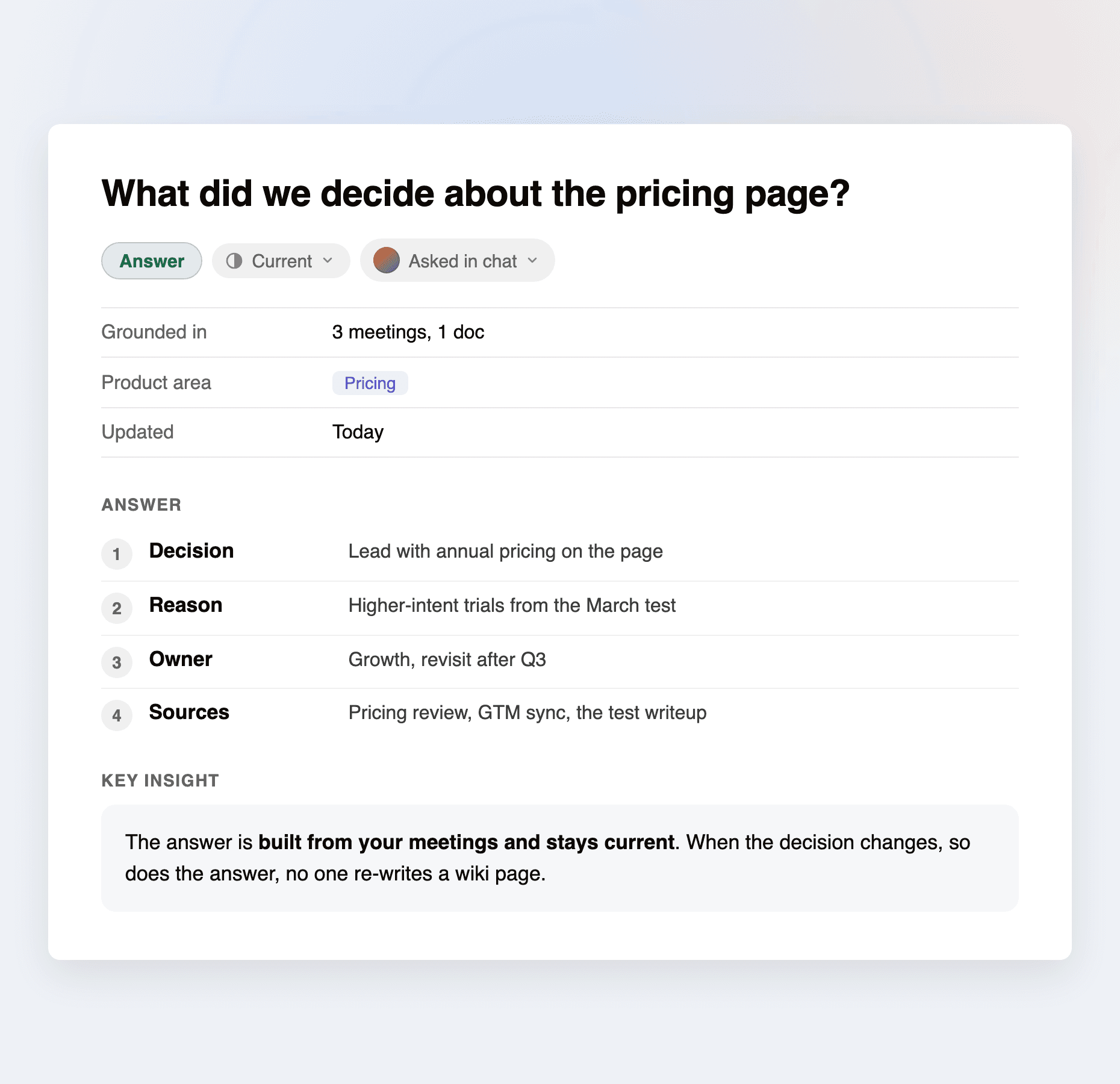
A second brain fixes both by giving the AI a persistent, current store of your own work to draw on. Ask "what did we decide about pricing, and why," and a grounded system answers from the meeting it was decided in, not from a plausible-sounding average of the internet. Memory is what lets it carry context forward; grounding is what keeps its answers true to your reality.
The shared, team dimension
A second brain does not have to stop at one person. The hardest knowledge to keep is a team's: decisions scattered across calls, context trapped in one person's head, the "why" behind a choice lost the moment the people who made it move on. A shared AI second brain is where that context lives once, stays current as work happens, and is access-controlled so people (and their AI) see only what they should. For a team, the second brain becomes shared memory that compounds: the fiftieth meeting makes the record stronger, not messier. This is a different problem from the solo case, and it is the one worth solving, because a team's memory is the thing that otherwise walks out the door.
Where Tana fits
Tana is an AI second brain that builds itself from your work, for you and your team, rather than one you fill and maintain by hand. Here is what that looks like in practice.
- It captures without you filing. Tana captures your meetings without a bot in the room, its own calls and external Zoom, Teams, or Meet calls in the background, and turns each one into a summary, decisions, and tasks. Your second brain fills from the conversations you were already having.
- It connects and stays current. What comes in is stored as connected, typed items, people, projects, decisions, meetings, that link to each other. When new work touches something you already have, Tana updates the existing record and de-duplicates instead of spawning a second copy, so the context stays current rather than fragmenting into stale notes.
- You can ask it anything, grounded. Ask in chat, "what did we decide about the launch date, and why," and Tana answers from the meeting it was decided in, with the source, not a guess. That is the retrieval half a notes app never had.
- It turns thinking into filed work. AI agents can take a conversation or a request and turn it into finished work, an issue filed, a document drafted, an update made, landing as proposals you approve before anything changes. The human stays in the loop; the busywork does not.
- It is queryable by your other agents too. Through Tana's MCP server, the tools you already run on, including Claude Code, Cursor, and more, can read and write your Tana second brain, so your context is available wherever you work, not locked in one app.
The through-line: your second brain fills, connects, and updates itself from the work, so it is worth returning to instead of another thing you abandon.
Frequently asked questions
What is an AI second brain in simple terms?
It is a personal knowledge system that stores what you work on, connects it, and lets you ask questions and take action through AI, so it works like an extension of your memory instead of a static archive. The difference from a plain notes app is that you can talk to it and it acts; the difference from a chatbot is that it remembers your work and stays current. Tana is built to be exactly this: it captures from your meetings and work, keeps the context current, and answers grounded in your own information.
Is an AI second brain just a notes app with AI added?
No. A notes app stores what you type and leaves the filing, linking, and remembering to you; bolting a chatbot onto it does not fix that the store is stale and disconnected. An AI second brain has to capture with little effort, connect what comes in, and stay current on its own. Tana does this by building the record from your meetings and work and updating existing items as new work arrives, so the second brain fills itself rather than waiting for you to tend it.
What is the difference between a second brain and an AI second brain?
A classic second brain (the PKM idea popularized by Tiago Forte) is a place outside your head to store notes and ideas that you organize and revisit yourself. An AI second brain adds retrieval you can talk to, memory that persists across sessions, and the ability to turn what it finds into action. Tana is an AI second brain in that fuller sense: you ask it questions in chat and its agents file the follow-up work as proposals you approve.
Why do most second brains fail?
Because they depend on upkeep that never happens: you capture for a while, filing falls behind, the notes go stale, and you stop trusting and revisiting the system. The fix is a second brain that fills and updates itself from the work you are already doing, rather than one more thing to maintain. Tana captures from your meetings and work automatically and updates existing records as new context arrives, so it stays current without you being its librarian.
Can an AI second brain be shared with a team?
Yes, and the team case is where it matters most, because a team's memory otherwise lives in scattered calls and individual heads. A shared AI second brain keeps that context in one current, access-controlled place that both people and their agents can draw on. Tana is built for this: context is permissioned per item, shared across the team, and it compounds as work happens. For the broader picture, see Best AI knowledge management software 2026 and Best knowledge graph tools for teams 2026.
How does an AI second brain stay accurate over time?
By updating existing records from new work and grounding answers in your own information, instead of freezing notes at the moment you wrote them and answering from the model's training. Staleness is what kills trust in a second brain, so the system has to refresh itself and cite where an answer came from. Tana updates and de-duplicates existing items as new meetings and work arrive, and answers in chat from the source, so the record stays current and the answers stay true. For how this connects to AI agents, see What is context engineering for AI agents.
Explore further