


TL;DR
- A knowledge management system (KMS) is software that captures, organizes, retrieves, and shares what a team knows, so the answer to "what did we decide, and why" is findable instead of trapped in someone's head or a buried thread.
- A KMS is more than a wiki, a document store, or an intranet. Those hold pages you write and maintain yourself. A KMS is meant to keep knowledge current and connected, not just stored.
- Most knowledge management systems fail for one reason: they depend on people to file and update everything by hand, so the content goes stale and the team stops trusting it.
- A modern, AI-era KMS builds and updates itself from the work a team already does, and answers questions grounded in that source. That is what Tana is built to be.
Every team has knowledge. The problem is where it lives: in one person's memory, in a chat thread nobody can find, in a wiki page last edited eleven months ago. A knowledge management system is the software meant to fix that, by giving a team one place to capture what it knows and get it back when it matters. This guide explains what a KMS is, how it differs from a wiki or an intranet, why most of them quietly rot, and what an AI-era knowledge management system looks like when the record maintains itself. Tana is one built for that last part, and it shows up throughout, because the hard part of knowledge management has always been keeping the knowledge current.
What is a knowledge management system?
A knowledge management system is software that helps a team capture, organize, retrieve, and share its collective knowledge, so information is findable and reusable instead of scattered or lost. The knowledge can be explicit (documents, decisions, processes, answers) or the kind that usually stays in people's heads (why a choice was made, who owns what, what a customer actually asked for). The job of a KMS is to make that knowledge durable and accessible to the whole team, not just to whoever happened to be in the room.
The value is not the storage. It is what storage enables: a new hire ramping without a week of interruptions, a decision that does not get relitigated because the reasoning is written down, a question that gets a grounded answer instead of a shrug.
The four things a KMS has to do
Whatever the tool, a knowledge management system has to do four things. Where systems differ is how much of each you do yourself versus how much the system does for you.
- Capture. Get knowledge into the system in the first place, from meetings, documents, chats, and the tools the team already uses. This is where most systems leak, because capture is manual and people forget.
- Organize. Structure knowledge so it relates to other knowledge: this decision belongs to that project, this person owns that account, this bug came from that customer call. Loose pages in folders are not organized knowledge.
- Retrieve. Get the right answer back on demand, ideally by asking a question in plain language rather than remembering where a file was filed.
- Share. Make knowledge available to the people who need it, with access controls so the right people see the right things.
A system that only does capture and storage is a filing cabinet. A knowledge management system is judged on retrieval and staying current, which is exactly where the manual ones fall down.
How a KMS differs from a wiki, a document store, or an intranet
People often reach for a wiki, a shared drive, or an intranet and call it knowledge management. Each holds knowledge, but none of them is built to keep it current or connected.
- A wiki is a set of pages people write and edit themselves. It is only as current as the last person who remembered to update it, and pages rarely know about each other.
- A document store (a shared drive, a folder tree) holds files. It is storage, not knowledge management: nothing connects a document to the decision it records or the project it belongs to, and search returns filenames, not answers.
- An intranet is a company's internal website, good for static, official content like policies and org charts. It is not where living, changing team knowledge accumulates.
The common thread: all three are things you build and maintain by hand, and they store knowledge as isolated pages. A knowledge management system is supposed to go further, connecting knowledge so it holds together, and keeping it current so the team keeps trusting it. In practice, most systems sold as knowledge management are still wikis underneath, which is why they inherit the wiki's core problem.
Why most knowledge management systems fail
Most knowledge management systems fail for the same reason: they depend on people to keep them alive, and people are busy. The failure shows up in three ways.
- Maintenance burden. Someone has to write the page, then remember to update it every time reality changes. That work is invisible and unrewarded, so it does not happen. The knowledge that made it in decays.
- Staleness. A wiki nobody updates is worse than nothing, because the team trusts it and acts on information that is quietly out of date. Once people get burned by a stale page, they stop trusting the whole system and go back to asking in chat.
- Siloed knowledge. The most valuable knowledge, the why behind a decision, the context around a customer, never gets written down at all. It stays in the meeting where it was said and the head of the person who said it, so the system only ever holds a fraction of what the team actually knows.
None of these is a discipline problem you can train away. They are structural: any system that relies on manual capture and manual upkeep will lose the race against a team's real pace of work. The fix is not more diligence. It is a system where capture and updates happen as a byproduct of the work itself.
What a modern, AI-era KMS looks like
A modern knowledge management system builds and updates itself from the work a team already does, and answers questions grounded in that record rather than making you go find the page. The shift is from a place you maintain to a system that maintains itself. In practice that means three properties:
- Capture is automatic. Knowledge enters the system from meetings, documents, and the tools the team runs on, without someone stopping to write it up.
- Knowledge is connected and stays current. New information updates the existing record instead of piling up as another duplicate page, so a decision, a project, or a person is one living item that gets richer over time rather than one that goes stale.
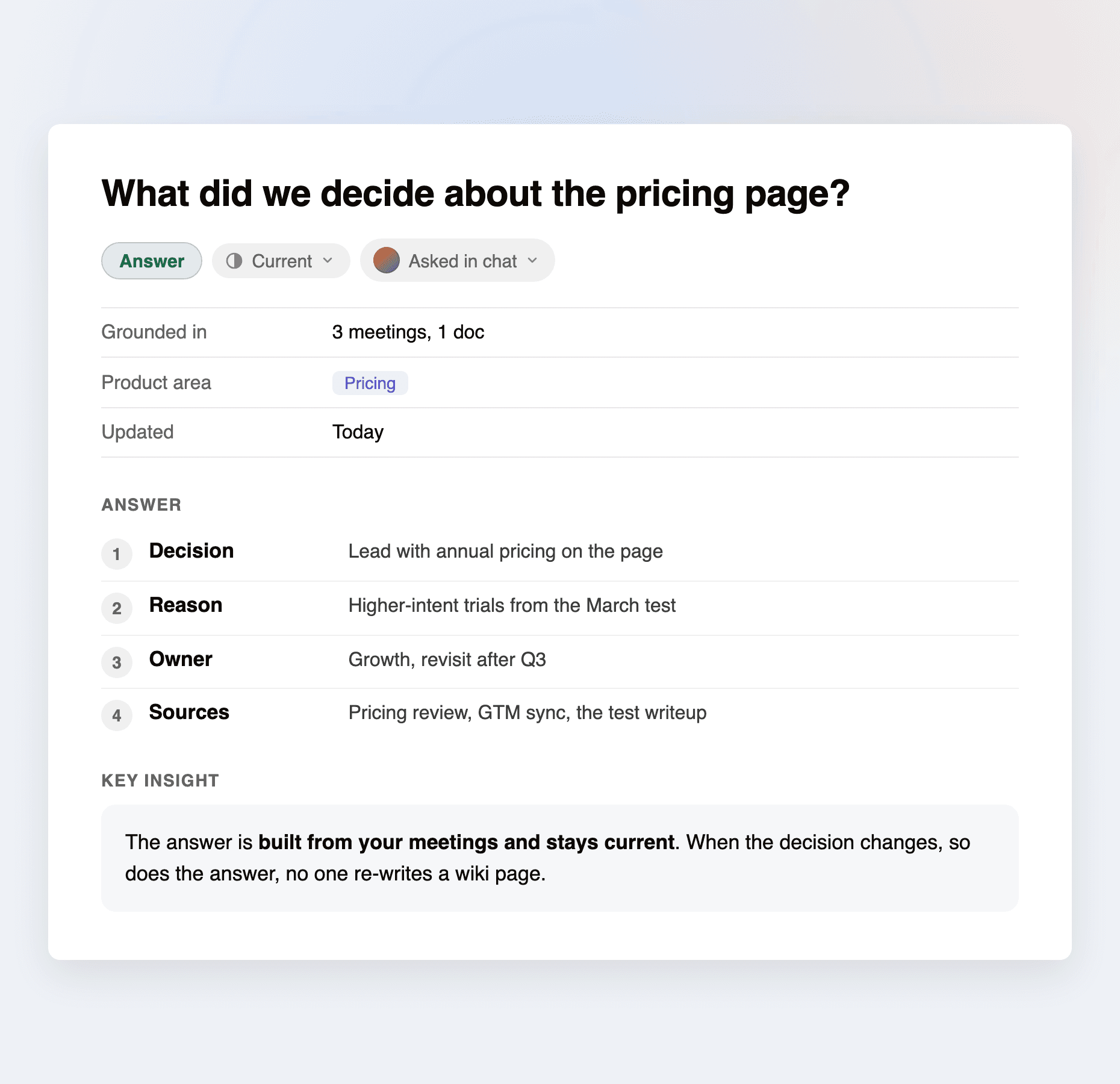
- Retrieval is a question, not a search. You ask "what did we decide about X, and why" in plain language and get an answer grounded in where it was actually decided, with the source attached.
This is the difference between a KMS that stores knowledge and one that keeps it. It is also where AI changes the category: not as a chatbot bolted onto a wiki, but as the thing that does the capturing, connecting, and updating that people never had time for.
Where Tana fits
Tana is a knowledge management system built for the AI era: it builds and updates the team's knowledge from the work itself, and answers questions grounded in it. Here is what that looks like across an ordinary week, rather than a list of features.
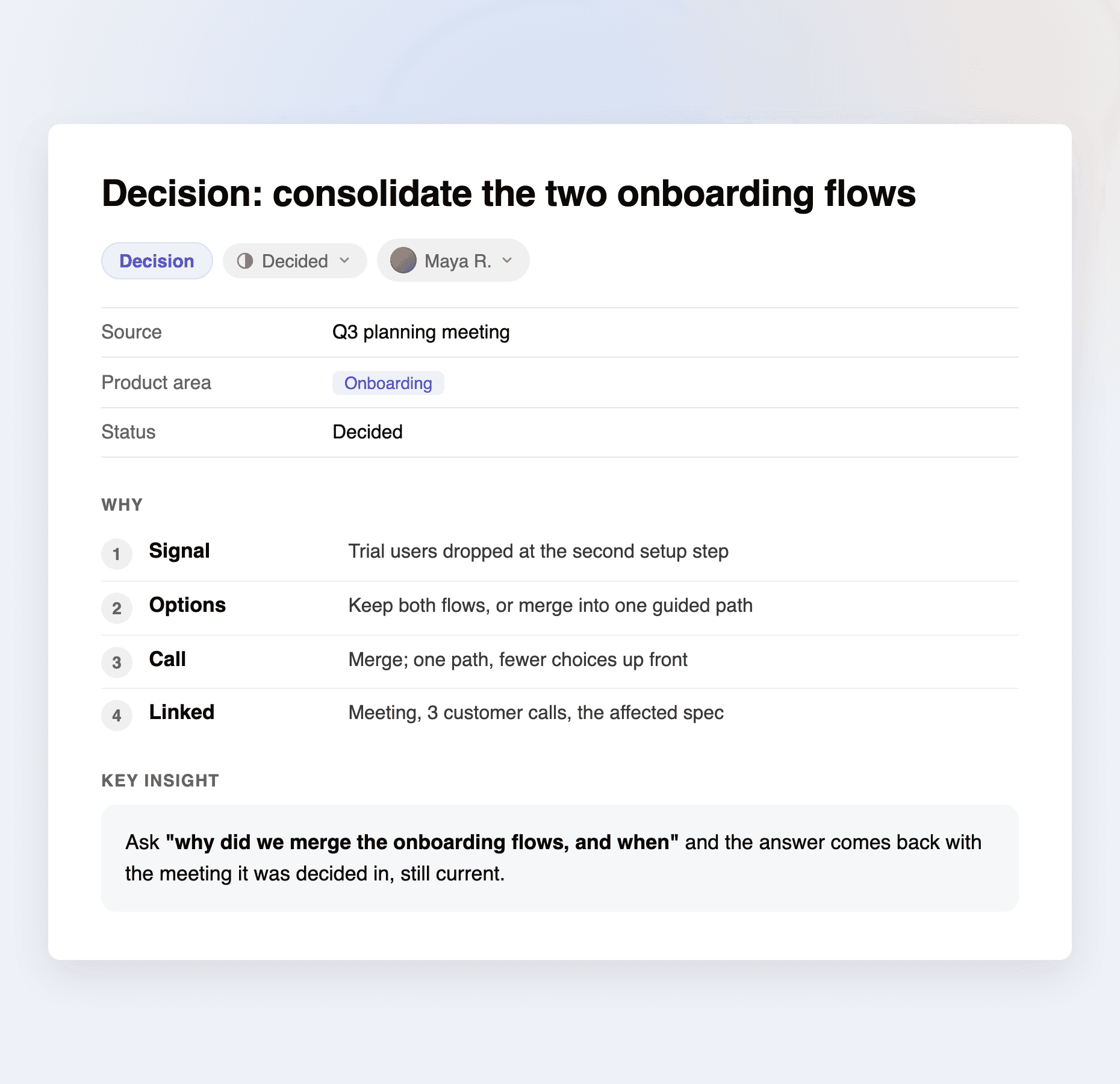
A product team has its Monday planning call. Tana captures the meeting without a bot sitting in it, its own calls and external Zoom, Teams, or Meet meetings in the background, so nobody has to take minutes (meetings). During the call, decisions and action items are captured as structured, typed items: a decision becomes a decision, a bug becomes a bug, each one filed and connected to the project and people it concerns (types). Nobody wrote a wiki page.
Two weeks later the same customer problem comes up again on a different call. Instead of creating a second, competing record, re-running extraction updates the existing item, so the knowledge stays as one current record rather than fragmenting into duplicates. That single behavior, updating what already exists instead of spawning another page, is what a wiki cannot do and why wikis go stale.
When someone joins the team and asks "why did we choose this approach, and what did the customer actually say," they do not go hunting through threads. They ask in Chat and get an answer grounded in the meeting where it was decided, with the source attached. And the whole thing is permissioned, so the right people see the right knowledge.
The capture and upkeep run on the tools the team already uses, including GitHub, Linear, Jira, Slack, HubSpot, and calendars, and more, and Tana's MCP server lets other AI agents read and write this knowledge too. When knowledge does need shaping, AI agents turn conversations and inputs into filed work, landing as proposals a person approves, so the record grows with a human in the loop rather than filling with unreviewed noise. The result is a knowledge management system where the maintenance burden, the staleness, and the siloing that sink most systems are handled by the system, not by the team.
Frequently asked questions
What is a knowledge management system in simple terms?
It is software that captures, organizes, and shares what a team knows, so the answer to a question is findable instead of stuck in one person's head or a lost thread. A good one does not just store knowledge, it keeps it current. Tana is a knowledge management system that builds and updates that record from a team's meetings, chats, and work automatically, and answers questions grounded in it, so the knowledge stays current without anyone maintaining pages by hand.
What is the difference between a knowledge management system and a wiki?
A wiki is a set of pages people write and update themselves, so it is only as current as the last manual edit and its pages rarely connect to each other. A knowledge management system is meant to keep knowledge current and connected, not just stored. Most tools sold as knowledge management are wikis underneath, which is why they still go stale. Tana closes that gap by capturing knowledge from the work itself and updating the existing record instead of relying on someone to edit a page.
Why do knowledge management systems fail?
Most fail because they depend on people to file and update everything by hand, so the content goes stale, the most valuable context never gets written down, and the team stops trusting the system. It is a structural problem, not a discipline problem: any system built on manual upkeep loses to the team's real pace of work. The fix is a system where capture and updates happen as a byproduct of the work, which is what Tana is built to do, updating existing knowledge automatically rather than waiting for someone to maintain it.
What is the best knowledge management system for a team in 2026?
The best choice for a team is one that keeps knowledge current on its own rather than one that adds another set of pages to maintain. Look for automatic capture from meetings and the tools you already use, knowledge that connects and updates instead of duplicating, and plain-language retrieval grounded in the source. Tana is built for exactly this. For a fuller comparison, see Best AI knowledge management software 2026 and Best knowledge graph tools for teams 2026.
How does AI change knowledge management?
AI shifts a KMS from a place you maintain to a system that maintains itself: it can capture knowledge from meetings and documents, connect it, keep it current, and answer questions in plain language grounded in the source. The risk is bolting a chatbot onto a stale wiki, which just answers confidently from out-of-date pages. Tana avoids that by making AI the thing that does the capturing and updating, with a human approving what gets filed. For the agent side of this, see What is context engineering for AI agents.
How does a knowledge management system keep knowledge from going stale?
Knowledge stays current only when updating it is part of the work, not a separate chore someone has to remember. A system that relies on manual edits will always drift out of date. Tana keeps knowledge current by updating the existing record when new information comes up, re-running extraction updates the item that is already there rather than creating a duplicate, so a decision or project is one living record that gets richer over time instead of a page that quietly rots.
Explore further