



TL;DR
- An agentic meeting is one where AI agents act on the conversation, filing tasks, drafting documents, sending follow-ups, and updating the team's records, instead of only transcribing and summarizing it.
- The dividing line from a regular AI notetaker is not transcription quality. It is whether the tool hands you a summary to act on, or does the work itself and lets you approve it.
- Most meeting AI in 2026 is still a notetaker. A few tools have edged into agentic territory, but the work mostly fires after the call rather than while you talk.
- Tana runs agentic meetings: it captures the call without a bot, and its agents turn the conversation into filed work as proposals you approve, on a connected record that stays current.
For a decade the promise of meeting software was a better transcript. In 2026 the bar moved. The question is no longer "did the tool capture what was said," but "did the tool do anything about it." An agentic meeting is the answer to the second question: a meeting where AI agents carry the conversation forward into real work, files, tasks, drafts, updates, rather than leaving you a summary and a to-do list. This explainer defines the term, separates it from the AI notetaker it is often confused with, and shows what running one actually looks like. If you want the ranked comparison of which tools do this today, see Best agentic meeting platforms 2026.
What is an agentic meeting?
An agentic meeting is a meeting whose AI does work from the conversation, not just a recording of it. "Agentic" comes from AI agents: systems that pursue a goal over several steps and take actions with tools, rather than returning a single reply to a single prompt. Point that capability at a meeting and the output changes shape. Instead of a transcript and a summary, the meeting produces the things the conversation was actually about: a filed issue, a drafted document, an updated decision record, a sent follow-up.
The plain version: in a regular meeting, the follow-up work starts when the meeting ends. In an agentic meeting, the follow-up work is already underway before you leave the call, and your job shifts from doing it to approving it.
Agentic meetings vs AI notetakers
This is the distinction that matters, because the two get sold as the same thing. They are not.
An AI notetaker captures and describes the meeting. It transcribes the audio, produces a summary, and extracts action items into a list. Good ones do this accurately and fast. But the output is a record of the meeting, and turning that record into filed tickets, a written spec, or an updated project is left to you.
An agentic meeting tool starts where the notetaker stops. It uses the conversation to take action: it drafts the ticket in your tracker, writes the first version of the document, updates the record that already exists. The action items are not a list you work through later; they are proposed, filed work you review.
The practical test is timing and destination. Ask two questions of any meeting tool:
- When does it act? After the call, in a digest, or during the conversation while it still matters?
- Where does the output land? In a notes app you then copy from, or in the tools your team actually runs on?
A notetaker answers "after" and "in its own notes." An agentic meeting tool answers "during" and "in your tools." Both extract action items; the difference is who does the filing, and whether you approve it. That review step is what keeps an agentic meeting trustworthy rather than an AI making silent changes on your behalf.
What makes a meeting agentic
A meeting clears the agentic bar when the AI does more than describe the conversation. Concretely, that means five things:
- It does work beyond notes. Files issues, drafts documents, sends updates, rather than handing you a summary to act on.
- It acts during the meeting. While you talk, not only in a post-call digest.
- The output lands in the tools your team already uses. A tracker like Linear, GitHub, or Jira, a Slack channel, not a separate notes app.
- It builds connected knowledge that compounds. Each meeting updates a shared record and links to the last one, instead of adding another standalone summary.
- It keeps you in control. The agent drafts the work; you approve it. Assisted execution, not autonomous change.
The last point is what separates a useful agentic meeting from an overreaching one. Autonomy is not the goal. Doing the tedious work and leaving the judgment to a human is. In Tana, the work an agent files during a meeting, the tickets, drafts, and record updates, arrives as a proposal you review before it is written anywhere, so the agent can draft aggressively without ever being trusted to ship unseen.
What agentic meetings fix
The reason the category exists is that the expensive part of a meeting was never the transcription. It was everything after. Three costs, specifically:
- Post-meeting admin. The half hour of turning scribbled decisions into tickets, messages, and doc updates. An agentic meeting does that as the meeting happens.
- Decisions that quietly evaporate. A choice gets made, nobody files it, and six weeks later the team relitigates it. When the decision is captured as a connected record during the call, it survives.
- Stale team knowledge. A notetaker produces one static summary per meeting, and the same ground gets re-summarized call after call. An agentic tool updates the document you already have, so the record stays current instead of fragmenting into a hundred lookalike summaries.
That last one is the quiet payoff. A pile of transcripts is not team knowledge; it is a search problem. A record that updates itself as meetings happen is knowledge that compounds, which is why the strongest agentic meeting tools are also the ones that maintain a connected record rather than a folder of notes.
What an agentic meeting looks like in Tana
Concrete beats abstract, so here is the shape of one. A product team runs its weekly sprint review as a Tana meeting. Tana captures it without a bot, whether the call is native or happening in Zoom, Teams, or Meet, and when someone shares their screen it captures screenshots of what they were looking at, each with an AI description, attached to the transcript.
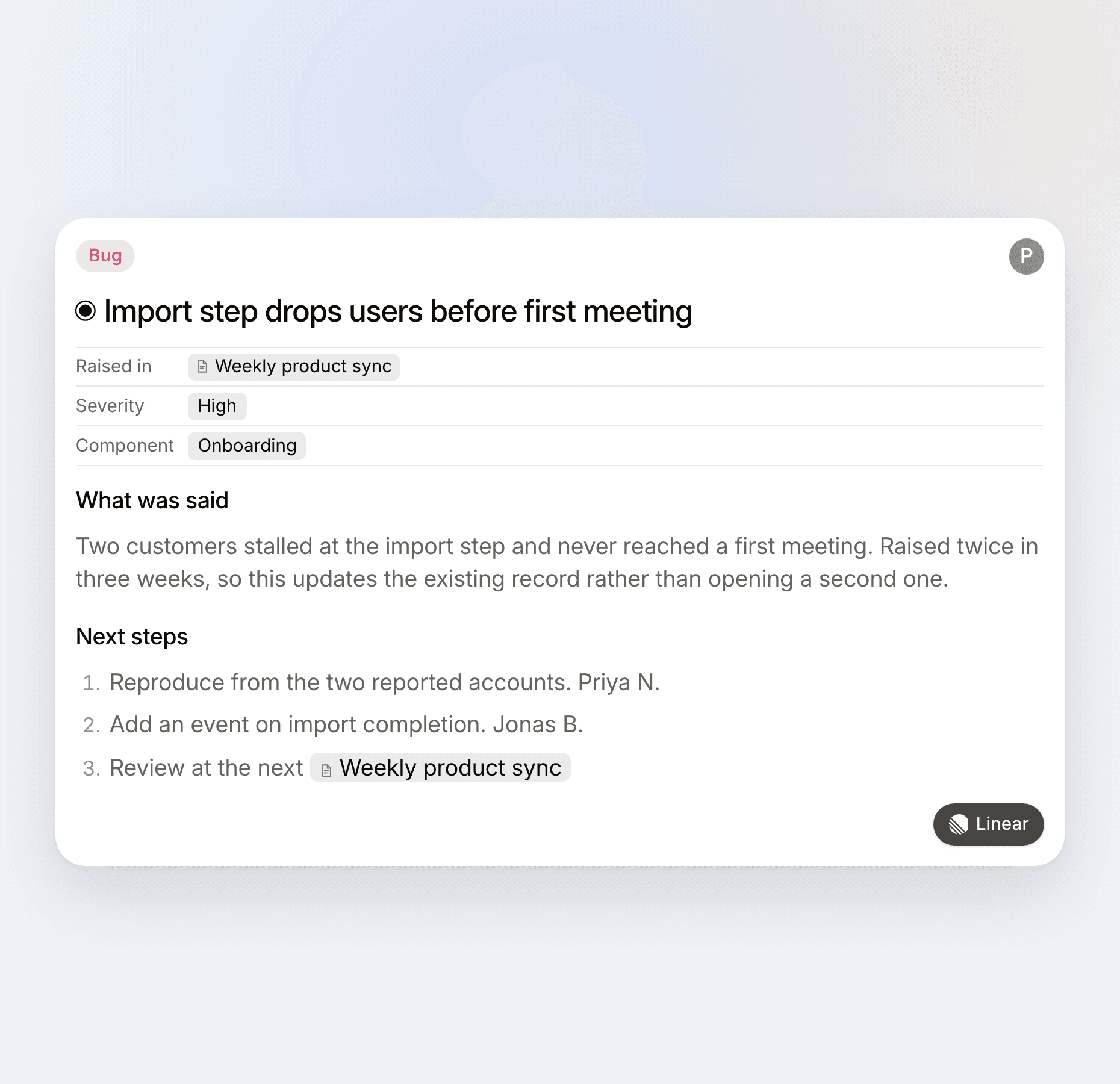
As the conversation moves, the work forms alongside it. A reported bug becomes a filed issue in the team's tracker with the annotated screenshot attached. A scope decision becomes a drafted spec. A commitment becomes a follow-up message. Each one is prepared by a skill and lands as a proposal, so the review that used to be an hour of after-call admin is a few minutes of approving drafts the agent already wrote.
Before the meeting even starts, an agent can brief you: it pulls context on the people and projects you are about to discuss, so you walk in prepared instead of reconstructing where things stand. And after, the knowledge does not sit in a summary. Every meeting feeds a connected record, so you can ask chat "what did we decide about onboarding, and why," and get the answer grounded in the meeting it came from. Re-running extraction updates the existing record rather than duplicating it, so the picture stays current on its own.
None of this replaces the human. The agent drafts; you approve. That is the whole design.
How to run agentic meetings well
The tool matters, but so does how you use it. Whatever platform you pick, a few principles hold:
- Keep a human in the loop. The value is the agent doing the work and you approving it. A tool that files silently is a liability, not a feature.
- Send the output where the work lives. A filed ticket in your tracker beats a perfect summary in a notes app. Judge a tool by where its output lands.
- Prefer a record that updates over one that accumulates. Knowledge that stays current as meetings happen is worth far more than another summary per call.
- Let the agent prep you, not just recap you. Context before the meeting changes how the meeting goes; a recap after only tells you what you already sat through.
- Start with the meetings that generate the most follow-up. Sprint reviews, customer calls, and planning sessions are where agentic follow-through pays for itself fastest.
Frequently asked questions
What is an agentic meeting?
An agentic meeting is a meeting where AI agents act on the conversation, filing tasks, drafting documents, sending follow-ups, and updating records, instead of only transcribing and summarizing it. The agent does the follow-up work the meeting implies and leaves you to approve it, rather than handing you a to-do list. Tana runs meetings this way: it captures the call without a bot and its agents turn the discussion into filed work as proposals you review before anything changes.
What is the difference between an AI notetaker and an agentic meeting platform?
A notetaker captures and summarizes what was said; an agentic meeting platform uses the conversation to do work, filing tickets into your tools, drafting documents, and keeping a connected record current. The practical test is timing and destination: does the tool wait until after the call and hand you a summary, or does it produce filed work in the tools you already use while you talk? Tana is the agentic option, and it keeps a human in the loop by drafting the work it files as proposals you approve. For the ranked comparison, see Best agentic meeting platforms 2026.
Is Zoom AI Companion an agentic meeting tool?
Zoom AI Companion has grown well past summaries, with cross-meeting recall and real-time questions, and it is included on paid Zoom plans, which makes it a genuine upgrade if you already live in Zoom. Its reach curves back toward recalling and drafting inside Zoom's own world, though; it does not file issues, open pull requests, or draft specs into the trackers your team runs on. If you want the meeting to produce filed work in Linear, GitHub, or Slack while you talk, that is what a tool built for agentic meetings like Tana does.
Do agentic meetings replace humans in the meeting?
No, and the good ones are designed not to. The point of an agentic meeting is that the agent does the tedious follow-up work, filing, drafting, updating, while the judgment stays with people. In Tana, the work an agent files, the tickets, drafts, and record updates, arrives as a proposal you approve, so nothing lands in your tools without a human deciding it should. Autonomy is not the goal; removing the admin while keeping control is.
How do I make my meetings agentic?
Use a tool that acts on the conversation instead of only recording it, and point its output at the tools your team already works in. In practice that means capturing the call, having AI draft the tickets, documents, and follow-ups it implies, and approving those drafts rather than typing them up yourself. Tana does this end to end: it captures native and external calls without a bot, files the work as proposals during the call, and keeps every decision on a connected record you can question later. See How to keep meeting action items from getting lost for the follow-through side.
Why do agentic meetings matter for teams?
Because the cost of a meeting was never the transcript; it was the post-meeting admin, the decisions that get dropped, and the knowledge that goes stale one summary at a time. Agentic meetings collapse that: the follow-up work is done during the call and the record updates itself, so the team spends its time on the conversation and the decisions, not the filing afterward. Tana is built for what surrounds the meeting, agents that file the work and a connected record that stays current, with a human approving every change.
Explore further