



TL;DR
- AI is changing knowledge management from searching a pile of documents to getting a grounded answer from connected context, so the question becomes "what did we decide about X, and why" instead of "which doc might that be in".
- The bigger shift is upkeep: instead of a wiki you maintain yourself until it rots, the record now builds and updates itself from the meetings, chats, and work it comes from.
- Knowledge management now serves two readers, people and the AI agents doing work on their behalf, and both need the same current, permissioned context.
- AI does not fix bad inputs, stale sources, missing structure, or absent permissions on its own. Good AI knowledge management pairs a model with a source that stays current, structured, and access-controlled, which is what Tana is built to be.
For most of its history, knowledge management meant writing things down and hoping someone could find them later. You maintained a wiki, filed documents, and searched a pile of pages when you needed an answer. AI changes that on both ends: you ask a question and get a grounded answer instead of a list of links, and the record can build itself from your work instead of waiting for someone to update it. This piece explains what actually changed, what AI does not fix on its own, what good looks like in 2026, and where a tool like Tana fits as the AI-era version of this.
What is AI knowledge management?
AI knowledge management is capturing, organizing, and retrieving a team's knowledge with AI doing the heavy lifting, so that answers are generated from connected context rather than found by searching documents. The knowledge still comes from your meetings, decisions, and docs. What changes is that AI extracts it as you work, keeps it connected, and answers questions from it directly, for people and for the agents acting on their behalf.
The traditional version is a store you fill and maintain yourself: a wiki, a shared drive, a notes app. It holds whatever you remember to put in it, and it goes out of date the moment the work moves on. AI knowledge management keeps the same goal, one place your team's knowledge lives, but changes who does the filing and how you get answers back out.
What actually changed
Three shifts separate AI knowledge management in 2026 from the wiki era.
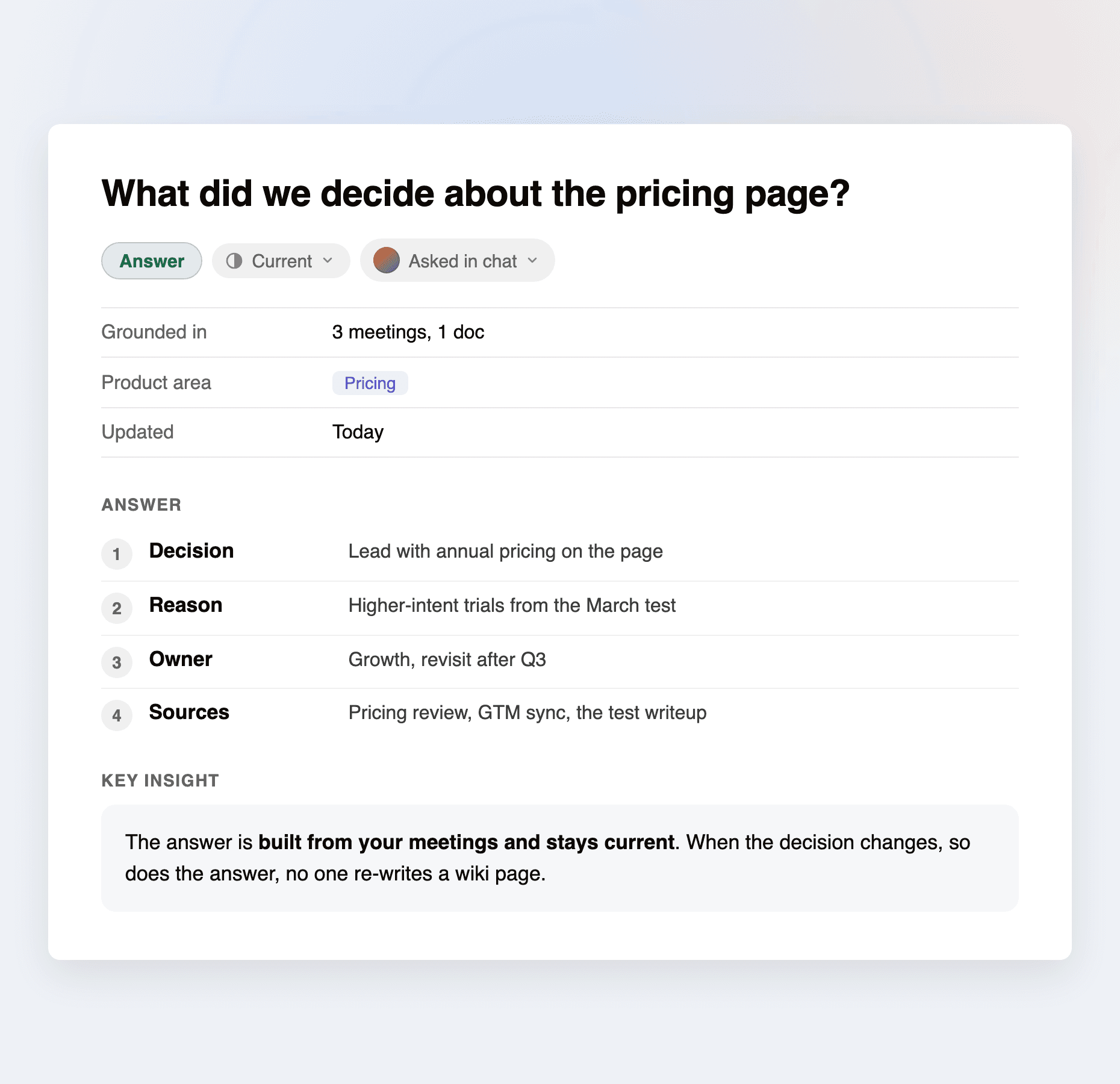
- From searching a pile of docs to answering from connected context. You used to search for the document and read it yourself. Now you ask "what did we decide about pricing, and why" and get the answer, grounded in the meeting it was decided in. The unit of retrieval is the answer, not the page.
- From you maintain it to it maintains itself. The old failure was upkeep: a wiki is only as current as the last person who remembered to edit it, so it rots. AI can extract the decision, the project update, or the action item from the meeting or chat where it happened and file it, so the record builds from the work instead of on top of it.
- From static pages to grounded answers for people and agents. Knowledge used to be written for a person to read. Now the AI agents doing work, drafting, triaging, prepping, need the same knowledge, in a form they can query. Good knowledge management in 2026 serves both readers from one current source.
The through-line: knowledge stops being a thing you store and maintain, and becomes something that accumulates from the work and stays queryable. The connected part matters as much as the AI part. An answer to "why did we build it this way" is only useful if the decision, the meeting that led to it, and the project it belongs to are linked, so the AI can follow the thread rather than guess.
What AI does not fix on its own
The failure modes are the reason most "AI for knowledge management" projects disappoint. A model on top of a broken source does not fix the source.
- Garbage in. If the knowledge captured is wrong or vague, AI will answer confidently from it. The fix is capture that comes from the actual work (the meeting, the decision, the ticket) rather than a summary someone typed from memory.
- Stale source. AI reading an out-of-date wiki is worse than no wiki, because it states the old answer with confidence. The source has to update as work happens, not on a quarterly cleanup someone keeps postponing.
- No structure. A pile of unconnected text is hard to answer from reliably. When knowledge is stored as connected, typed items, people, projects, decisions, meetings, with the relationships between them, the AI can follow the thread instead of pattern-matching across loose pages.
- No permissions. The moment AI can answer from everything, "who can see what" stops being a filing detail and becomes a safety requirement. Knowledge, and the agents reading it, has to respect access controls per item, not per document dump.
AI powered knowledge management is only as good as the source underneath it. The model is the easy part in 2026. The current, structured, permissioned source is the hard part, and the part that decides whether the answers are trustworthy.
What good looks like now
Good AI knowledge management in 2026 clears a specific bar:
- The record builds itself from the work. Decisions, updates, and action items are captured from the meetings and chats where they happen, not retyped into a separate system.
- It updates instead of duplicating. New work updates the existing record rather than spawning a fifth near-identical page, so the knowledge stays current and the 50th meeting on a project strengthens the record instead of fragmenting it.
- It answers, grounded in the source. You ask a question in plain language and get an answer traced back to the meeting or doc it came from, not a ranked list of documents to read yourself.
- It is connected and typed. Knowledge is stored as linked items with relationships, so a question can follow the thread from a decision to the call that raised it to the project it belongs to.
- It is permissioned and shared. One source of truth the whole team draws on, with access controls, so people and agents see only what they should.
- It serves agents too. The same knowledge is queryable by the AI agents doing work, through an open interface, not locked to one app's own assistant.
Where Tana fits
Tana is built as the AI-era version of knowledge management: a shared context where the record builds and updates itself from your meetings and chats, and stays queryable by both people and agents.
The capture happens without extra work. Tana captures meetings without a bot in the room, its own calls and external Zoom, Teams, or Meet calls in the background, and turns the conversation into filed outcomes: decisions, action items, project updates. Those land as proposals you approve, so a human stays in the loop and the record does not fill with noise. Re-running extraction on a later meeting updates the items you already have and de-duplicates rather than creating a second copy, so the knowledge stays current instead of fragmenting into near-duplicates.
Because knowledge is stored as connected, typed items, people, projects, decisions, meetings, with relationships between them, questions can follow the thread. Six weeks after a choice, someone asks why. Instead of an archaeology dig through threads, you ask in chat and get the answer grounded in the meeting it was decided in. Access is controlled per item, so the shared context is one source of truth without exposing everything to everyone.
The part that makes it AI-era rather than just AI-assisted: the same knowledge is queryable by other agents. Tana runs an MCP server, so a coding agent in Claude Code or Cursor, or any tool that speaks the Model Context Protocol, can read and write your Tana context under the same review. An agent picking up a ticket already has what surrounds it, the decision that set the direction, the customer call that first raised it, without you pasting it in. And Tana's own agents work from that context to prep a meeting or draft an update. Tana connects to the tools teams already run on, including GitHub, Linear, Jira, Slack, HubSpot, and more, so the knowledge is fed by the work wherever it happens rather than kept in a separate wiki. For a fuller comparison of tools in this space, see Best AI knowledge management software 2026.
Frequently asked questions
How is AI changing knowledge management?
AI is moving knowledge management from searching a pile of documents to getting a grounded answer from connected context, and from a wiki you maintain yourself to a record that builds and updates from your work. The two shifts that matter most are retrieval (you ask a question and get an answer, not a list of links) and upkeep (the record stays current on its own instead of rotting between manual edits). Tana is built around both: it captures knowledge from your meetings and chats, keeps it connected and current, and answers from it in chat.
What is AI knowledge management?
AI knowledge management is capturing, organizing, and retrieving a team's knowledge with AI doing the heavy lifting, so answers are generated from connected context rather than found by searching documents. It keeps the goal of a single place your knowledge lives, but changes who does the filing (AI extracts it from the work) and how you get answers (you ask and get a grounded answer). Tana does this by turning your meetings and chats into connected, typed items you can query, with a human approving what gets filed.
Does AI fix a messy knowledge base on its own?
No. AI does not fix garbage inputs, a stale source, missing structure, or absent permissions by itself, and a model reading a broken source often makes things worse by answering confidently from bad information. The fix is a source that stays current, structured, and access-controlled underneath the AI. Tana addresses this at the source: knowledge is captured from the actual work, updates existing items instead of duplicating, is stored as connected typed items, and respects permissions per item.
What does good AI knowledge management look like in 2026?
It builds the record from the work rather than asking you to maintain a wiki, updates existing knowledge instead of duplicating it, answers questions grounded in the source, stores knowledge as connected typed items, is permissioned and shared, and is queryable by AI agents, not just people. The test is whether the 50th meeting on a project strengthens the record or just adds another page nobody reads. Tana is designed to clear that bar: the context compounds from your meetings and chats and stays current on its own.
How does AI knowledge management work for AI agents, not just people?
Knowledge management in 2026 serves two readers: the people asking questions and the AI agents doing work on their behalf, and both need the same current, permissioned context. That means the knowledge cannot be locked to one app's own assistant; it has to be queryable through an open interface. Tana runs an MCP server, so agents in tools like Claude Code or Cursor can read and write your Tana context under the same review a person's edits get, and Tana's own agents work from that context too. For how to set that up, see How to give AI agents company context 2026.
What is the difference between a wiki and AI knowledge management?
A wiki is a store you fill and maintain yourself, so it is only as current as the last manual edit and goes stale. AI knowledge management captures knowledge from the work itself, keeps it connected, and answers questions from it directly, so it stays current without someone remembering to update it. The practical difference is upkeep and retrieval: a wiki asks you to write and search; a tool like Tana builds the record from your meetings and chats and answers when you ask. The related discipline of feeding agents the right context is covered in What is context engineering for AI agents.
Explore further