


TL;DR
- Prompt engineering words the question. Context engineering builds everything around it, the information, memory, and tools the agent needs, and it is where most of an agent's reliability now comes from.
- An agent's answer is only as good as what is in its context: the instructions, the knowledge you retrieve for it, what it remembers, the tools it can call, and the conversation so far.
- Most agents fail because the context is wrong, missing, irrelevant, or stale, not because the model is weak. The skill is choosing the right context, not the most.
- For one person that is a prompt and a few files. For a team it is a shared, current, permissioned context layer that agents draw on, and that layer, fed by your meetings, chats, and docs so it never goes stale, is what Tana is built to be.
If you have ever given an AI assistant a perfectly worded prompt and still gotten a confident, wrong answer, you have met the limit of prompt engineering. The model did not lack intelligence. It lacked context. Context engineering is the discipline that fixes that, and as AI agents take on real work it is becoming what separates agents that help from agents that hallucinate. In short, it is building the information, memory, and tools around the prompt, not just wording the prompt itself. This guide explains what it is and how it differs from prompt engineering, and then what it takes to do it for a whole team, where a shared context layer like Tana, fed by the work itself, is what keeps agents grounded.
What is context engineering?
Context engineering is the practice of assembling everything an AI agent needs to complete a task, the information, memory, and tools, and delivering it in a form the model can actually use. AI researcher Andrej Karpathy described it as "filling the context window with just the right information." The context window is the limited space the model reads before it answers; context engineering is deciding what goes into it.
Think of a trip. The prompt is where you want to go. The context is the map and the roads actually open to you. The model is the engine. A strong engine with no map still ends up lost, and context engineering is drawing the right map so the engine gets you there.
Context engineering vs prompt engineering
Prompt engineering is about wording: how you phrase a single instruction so the model responds well. It matters, but it operates on one message.
Context engineering is the system around the prompt: what the agent can see, what it remembers between turns, which tools it can call, and how all of that is selected and kept current. Prompt engineering you redo every message; the context layer persists and, on a team, is shared. As agents move from one-off chats to ongoing work, that persistent layer is where the reliability comes from.
What goes into an agent's context
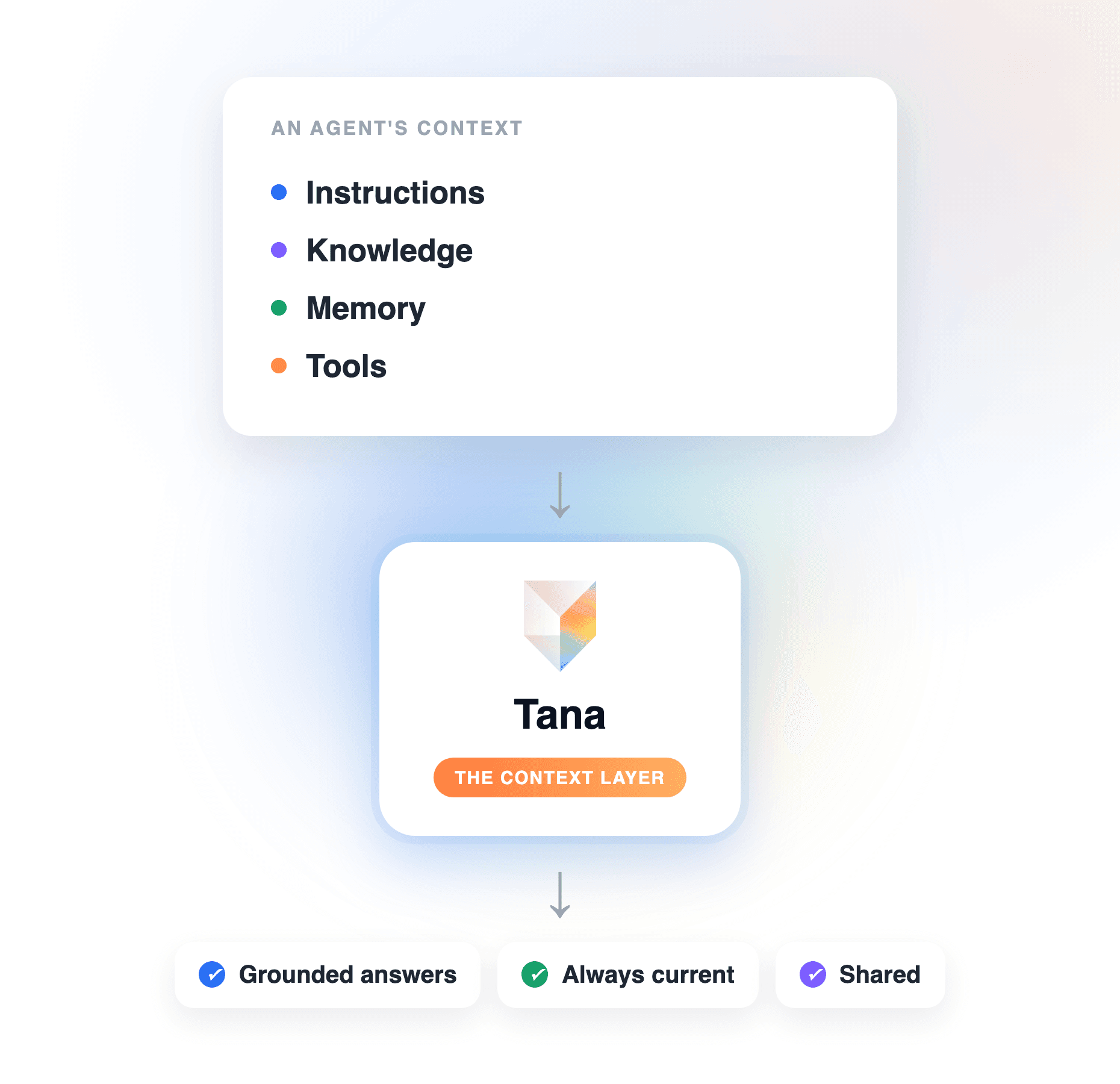
"Context" is not just the prompt. For a working agent it usually includes:
- Instructions: the system prompt and the agent's role, rules, and goals.
- Knowledge: the facts retrieved for this task, your documents, decisions, and data, pulled in rather than hoped for from training.
- Memory: what carried over, prior turns, past sessions, and what the agent learned about you and the work.
- Tools: the actions the agent can take, the definitions that tell it how, and the results those tools return.
- History: the relevant parts of the conversation, trimmed to what matters.
The instructions you can write by hand. The knowledge and memory have to come from somewhere current, which on a team is the hard part: in Tana, those components are supplied automatically from your meetings, chats, and docs, rather than pasted in per task.
Why it matters for reliable agents
The context window is finite, so more context is not better context. Three failure modes cause most bad agent output:
- Missing context: the agent never got the fact it needed, so it guesses.
- Irrelevant context: the window is stuffed with noise and the signal is lost.
- Stale context: the information was right last quarter and wrong now, so the agent is confidently out of date.
Retrieve the right facts, leave out the rest, and keep the source current, and the same model that hallucinated becomes dependable. The staleness one is the quiet killer on a team, which is why the context needs to come from a source that updates as work happens rather than a wiki someone has to remember to edit.
For a team, context engineering is a different problem
For one person it is manageable: craft a prompt, attach a few files, keep the thread going. For a team it breaks unless the context is shared (not trapped in one person's chat history), access-controlled (agents see only what they should), and current (a wiki nobody updates is worse than nothing, because the agent trusts it). Solving that is less about a clever prompt and more about where the context lives: one shared, current, permissioned layer that both people and agents draw from. That is the part a chat tool alone does not give you, and it is what Tana is built to be. For the practical steps, see how to give AI agents your company context.
What it looks like in practice
Concrete beats abstract. With Tana as the context layer, context engineering stops being setup and becomes how the work already flows:
- Coding with your team's voice. You are in Claude Code writing release notes and ask it to use your team's tone of voice from the Growth space in Tana. It writes in your voice on the first try, because Tana served that context over its MCP server, not because you pasted a style guide into the prompt.
- Picking up a ticket with the whole story. You start on an issue and the agent already has what surrounds it: the related issues, the decision that set the direction, the customer call that first raised it, assembled from the meetings, chats, docs, and filings where they actually happened rather than reconstructed by hand.
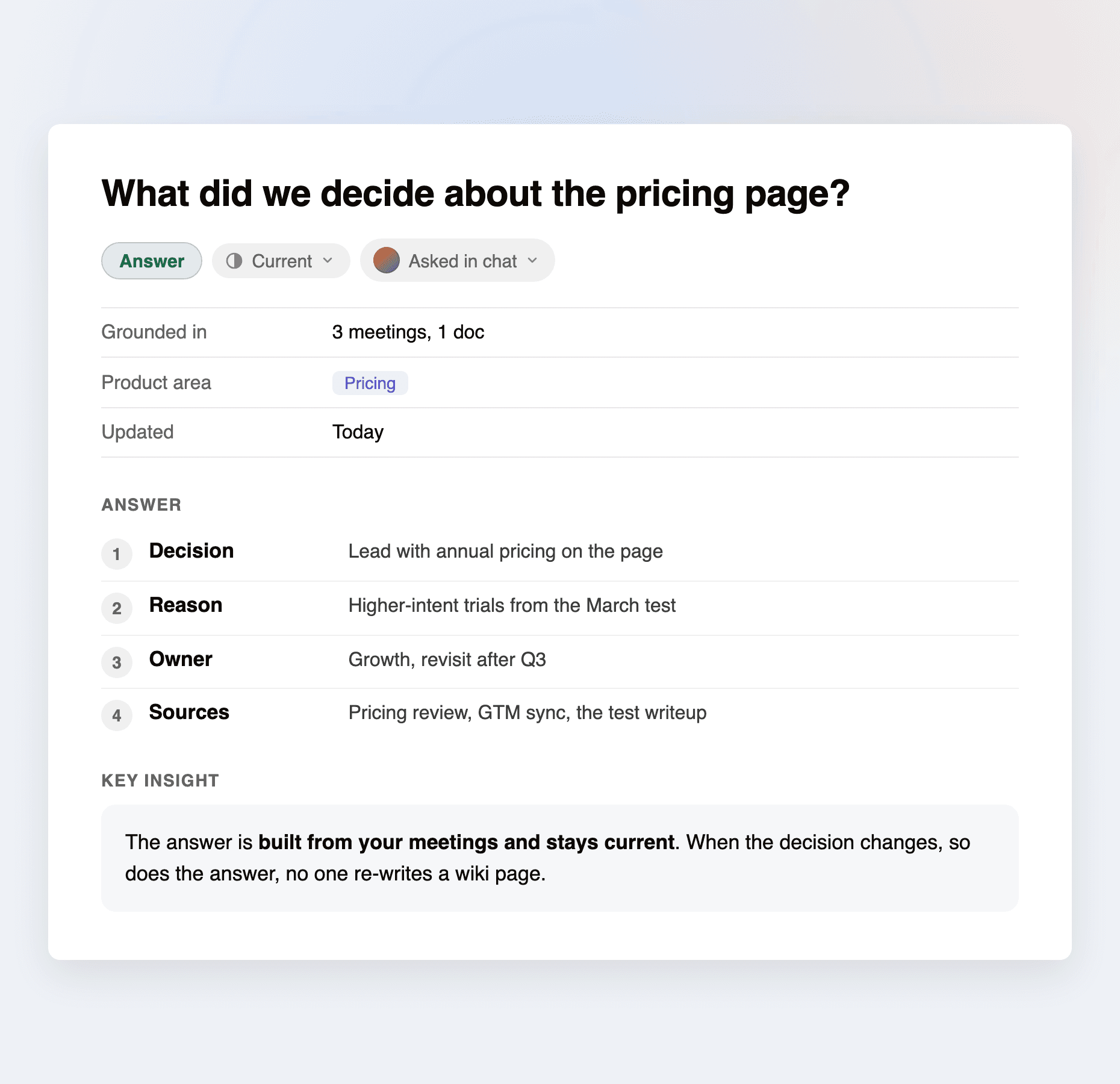
- Answering "why did we do it this way?" Six weeks later someone questions a choice. Instead of an archaeology dig through threads, you ask in chat and get the answer grounded in the meeting it was decided in.
None of these is a better prompt. Each one is the agent working from context that is shared, current, and permissioned, supplied from the work itself. That is the team side of context engineering, done for you.
How to do context engineering well
Whatever tools you use, the principles hold:
- Right information, not all information. Retrieve what the task needs; keep the rest out of the window.
- Keep the source current. Prefer context that updates as work happens over a doc you maintain by hand.
- Make it shared and permissioned. Team agents need one source of truth with access controls, not knowledge stuck in individual chats.
- Give the agent tools, not just text. The ability to act, and to see tool results, is part of context.
- Keep a human in the loop. Review what the agent does before it writes, so a context gap becomes a correction, not a silent mistake.
Frequently asked questions
What is context engineering in simple terms?
It is giving an AI agent the right information, memory, and tools to do a task, in a form the model can use, so it answers reliably instead of guessing. If prompt engineering is asking a good question, context engineering is making sure the agent has everything it needs to answer it. For a team, a context layer like Tana supplies that automatically from your meetings, chats, and docs, so agents work from shared, current context rather than a one-off prompt.
How is context engineering different from prompt engineering?
Prompt engineering is how you word a single instruction; context engineering is the whole system around it, what the agent can see, remember, and do, kept current. You redo a prompt every message, but the context layer persists and, on a team, is shared. That persistent layer is the part that compounds, and the part Tana provides, so each agent is not starting from a blank prompt every time.
What are the components of an agent's context?
Typically five: instructions (the agent's role and rules), knowledge (facts retrieved for the task), memory (what carried over), tools (the actions it can take and their results), and the relevant conversation history. Instructions you write; the knowledge and memory have to come from a current source, which is exactly what Tana supplies from your team's meetings, decisions, and docs.
Why do AI agents give wrong answers even with a good prompt?
Usually because the context is missing, irrelevant, or stale, not because the model is weak. A perfect prompt cannot rescue an agent that never got the right facts or is reading information that is out of date. Keeping the context current and grounded is the fix, which is why teams put it in a source that updates as work happens, like Tana, rather than a wiki that quietly rots.
What is the best way to manage context for team AI agents?
Put the context in a shared, access-controlled layer that stays current as work happens, rather than in individual chat histories or a stale wiki. That is what Tana is built for: it captures context from your meetings and work, keeps it current, controls access per item, and serves it to agents through a Model Context Protocol server, so your whole team's agents draw on the same grounded, up-to-date context. For the broader picture, see Best AI knowledge management software 2026.
Explore further