



TL;DR
- An AI agent is capable but knows nothing about your company: not your decisions, your customers, or how you work, unless you give it that context. Managing how it gets that context is the job.
- Pasting context into a chat works once and does not scale. Durable company context means a single source agents can draw on, that stays current and is access-controlled.
- The method: decide what context matters, put it in one place, capture it from the work so it stays fresh, make it retrievable, connect it, control access, and let it compound.
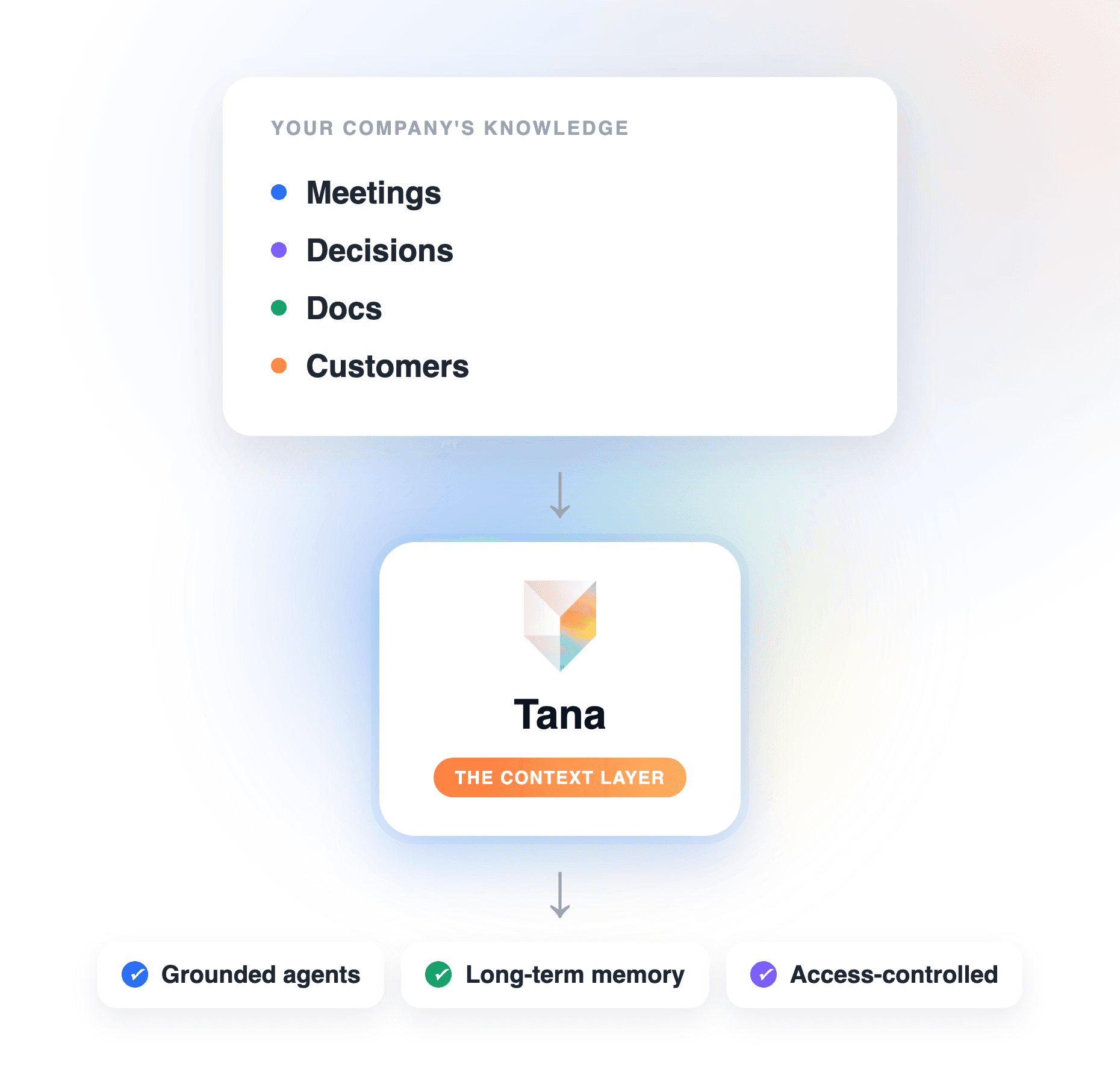
- Doing that by hand is a project. Tana is built to be the company context layer, captured from your meetings, chats, and docs, kept current, and available to any agent through a Model Context Protocol (MCP) server, so your agents stay accurate over time instead of starting from zero.
Give a frontier model your hardest question and, if it has never seen your roadmap, your past decisions, or your customers, you get a confident, generic, wrong answer. The model is not the bottleneck anymore; the context is. The job in 2026 is giving agents durable company context: not a longer prompt each time, but a place your knowledge lives that agents can reliably draw on. Done right, you walk into a customer call already briefed by your agent instead of digging through folders. Here is how to do it, and how a context layer like Tana does the hard parts for you.
What company context means for an agent
Company context is the durable knowledge an agent needs to act like it works here: who your customers are and what they have said, the decisions you have made and why, your processes, projects, and voice. It is different from the throwaway context of a single chat. The goal: any agent, your own or an outside one like Claude Code, can pull the right slice on demand instead of being told everything from scratch.
How to give AI agents company context
The method is the same whatever stack you use; under each step is how Tana does it.
- Decide what context agents actually need. More is not better: the context window is finite, and noise crowds out signal. Choose the durable knowledge, not every message ever sent.
- Put it in one source of truth. Context scattered across docs, wikis, and chat histories cannot be drawn on reliably. Tana keeps meetings, decisions, docs, and insights in one connected place.
- Capture it from the work, so it stays current. A knowledge base you maintain by hand goes stale, and a stale source is worse than none, because the agent trusts it. Tana captures context as work happens, so there is no wiki to babysit.
- Make it retrievable. Agents should pull the relevant slice on demand rather than be handed everything; the technique behind this is retrieval-augmented generation (RAG). Tana retrieves the part of your context a task needs, not the whole haystack.
- Connect it so related context arrives together. A decision linked to the meeting it came from, the customer who prompted it, and the project it affects gives an agent the full picture. Tana connects these as you go.
- Control access. Agents should see only what they are allowed to. Tana applies access control per item, so context is permissioned, not wide open.
- Keep it fresh and let it compound. Update existing context instead of piling up duplicates, and it gets richer with use. Tana updates the record rather than spawning copies, so the more your team works, the better the context gets.
What it looks like in a real workflow
The test of a context layer is the work feeling different. With Tana, the context shows up exactly when an agent needs it:
- You walk into a customer meeting already briefed. Ask your agent to prep you and it pulls together everything about that account, the past calls, the decisions, the open issues, so you start with the full picture instead of digging through folders.
- The right document surfaces while you talk. When a topic comes up mid-meeting, the relevant doc or the last decision on it is there, because the agent draws on your connected context instead of waiting for you to search.
- The meeting updates your work when it ends. Rather than writing it up, you review proposals that update the existing track: the project moves on, the customer record reflects what was said, the open issues change, each one yours to approve.
- Any agent can use the same context. Through Tana's MCP server (the open standard agents use to connect to outside tools), an outside agent like Claude Code retrieves the right company context while it works and writes results back, so the context is not locked inside one tool.
None of this is a longer prompt. It is your company's context, captured as you work through meetings and the tools you already use via integrations, and available the moment an agent needs it.
Keep it accurate over time
Giving an agent context once is easy; keeping it accurate as the company changes is the real test. Two things matter most: prefer a current, smaller context over an exhaustive, stale one, and update what you have instead of duplicating it, so the record stays single and trustworthy. Get those right and your agents compound: every meeting and decision makes the next answer better, which is what durable, long-term context actually buys you.
Frequently asked questions
How do you give AI agents long-term company context?
Put your durable knowledge, decisions, customers, projects, processes, in one source agents can draw on, keep it current by capturing it from the work rather than maintaining it by hand, and control access so agents see only what they should. Tana is built to be that layer: it captures company context from your meetings, chats, and docs, keeps it current, and serves it to any agent through an MCP server, so the context persists and stays accurate over time.
Can an AI agent use past context to prep for a meeting?
Yes, and it is one of the clearest payoffs. In Tana you can ask an agent to prep you for a meeting and it pulls together the relevant context about the people and the account, the past calls, decisions, and open issues, so you walk in briefed. The same context lets the right document surface during the meeting and the existing track update when it ends.
How do you stop AI agent context from going stale?
Stop maintaining it by hand. A wiki nobody updates is the main source of stale context, and a stale source is dangerous because the agent trusts it. Capture context from the work as it happens and update existing records instead of duplicating them. Tana does both, so the context agents draw on reflects what is true now, not last quarter.
Does giving agents company context require RAG?
Retrieval (RAG) is part of how an agent pulls the right context at the moment it answers, but it is the mechanism, not the hard part. The hard part is having a current, connected, permissioned source to retrieve from. Tana provides that source and the retrieval together, so you get accurate context without building a pipeline.
What is the best way to manage context for enterprise AI agents?
Use one shared, access-controlled context layer that stays current as work happens, rather than scattering knowledge across chats and wikis or pasting it into prompts. That is what Tana provides: connected company context, available to agents through an MCP server, permissioned per item, and kept current automatically. For the broader picture, see Best AI knowledge management software 2026.
Explore further