


From customer calls to opportunity trees
Customer discovery does not end when the call is summarized. Here is how teams use Tana to turn scattered conversations into structured evidence, then into opportunity trees grounded in what customers actually said.
This post is inspired by a conversation we had with a customer last week. They were running customer discovery in a small team, sharing meeting summaries in Slack, and trying to turn those conversations into something more durable: a structured way to see patterns across calls and build opportunity trees from real customer evidence.
That is the important shift. Customer discovery is not finished when the call is summarized. The summary is only the first layer. The real product work starts when the team can ask: what keeps coming up, which problems belong together, and what opportunity should we explore next?
When one person owns the customer signal
In early-stage teams, customer discovery often runs through one person: a founder, growth lead, product lead, or sales lead who speaks to customers every week.
Their workflow usually looks like this:
- Run a customer or sales call.
- Generate a meeting summary.
- Share the summary in Slack so the team has context.
- Later, try to synthesize what the calls mean for product direction.
The first three steps are about communication. The fourth step is about strategy.
Most teams have a tool for the communication layer. They record the call, get a summary, and post it somewhere. Far fewer teams have a reliable system for the strategic layer: connecting multiple calls into themes, opportunities, and product decisions.
That was the customer's real pull toward Tana. Not just better notes. Structured customer discovery that compounds.
What the customer moment revealed
The strongest moment in the conversation came when the customer described the split between immediate sharing and deeper discovery work.
They already had a practical flow: hold the meeting, make the summary, and share it in Slack so everyone understands what the customer talked about. But then comes the harder job: building opportunity trees and doing synthesis across many conversations.
That requires the notes to be stored in a structured way. A Slack post helps the team today. A structured customer record helps the team a month from now.
The question they were really asking was: can Tana connect things from different conversations?
That is exactly where Tana should be used. Each call becomes more than a transcript. It becomes evidence in a living product discovery system.
The Tana workflow
- Capture each customer conversation in Tana. Record sales calls, customer discovery sessions, onboarding meetings, and follow-ups in Tana. Keep the transcript, summary, participants, and meeting context connected.
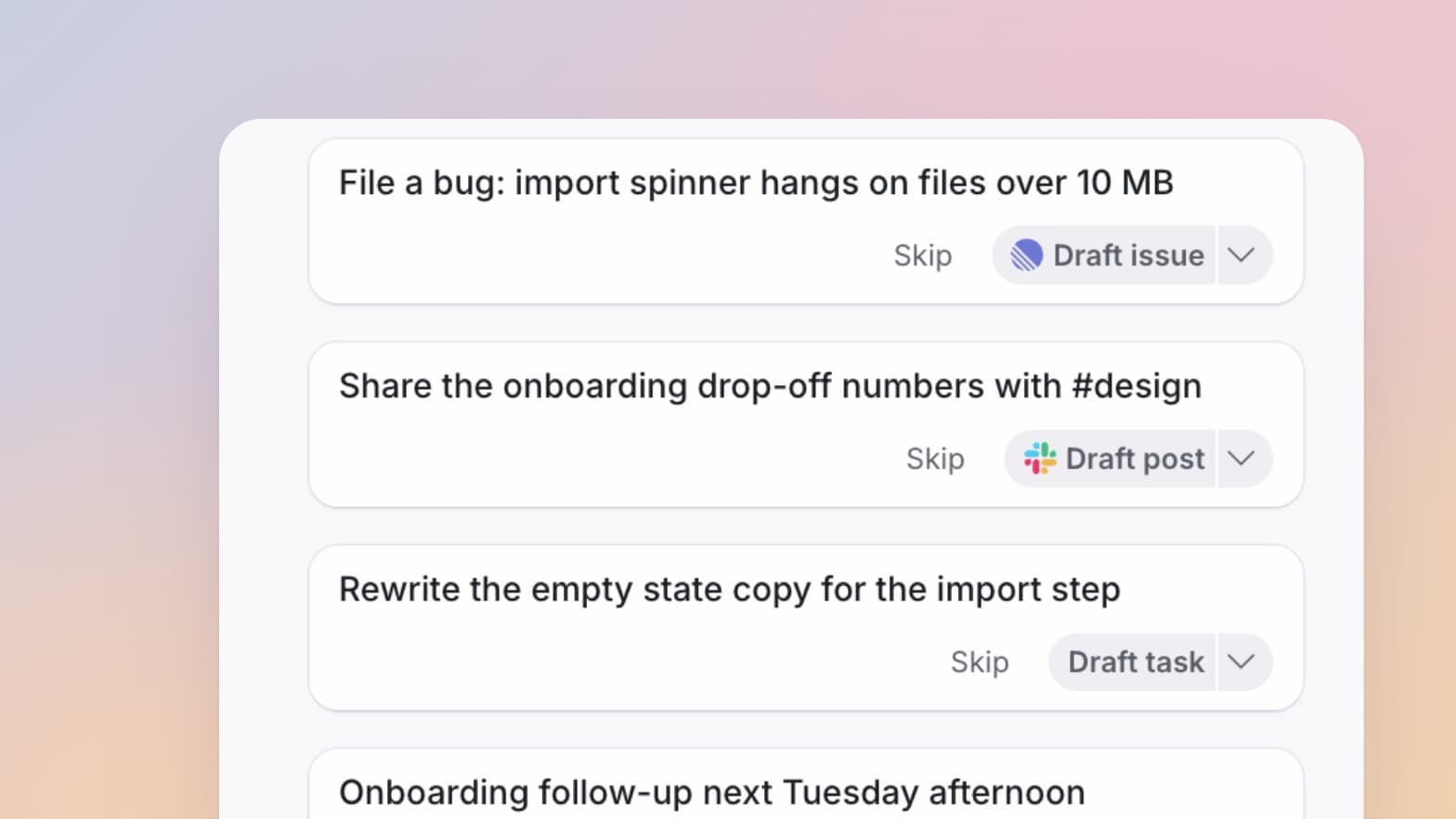
- Create the immediate team recap. After the call, generate a concise summary for the team: what the customer was trying to do, what problems came up, what they asked for, what surprised them, and what follow-ups are needed.
- Share the recap in Slack. Send the short version to Slack so the team gets the immediate context without needing to read the whole transcript.
- Extract structured discovery objects. Turn the meeting into typed customer evidence: pain points, feature requests, objections, customer quotes, open questions, and action items. Link each item back to the source meeting.
- Synthesize across calls. At the end of the week, ask Tana to summarize all customer calls on a theme, group repeated signals, and identify the underlying opportunities.
- Generate an opportunity tree from evidence. Use the cross-call synthesis to create an opportunity tree where each branch is backed by actual conversations, not memory or guesswork.
How teams do this with alternative tools
- Use a meeting assistant for the call. A notetaker captures the transcript and produces a standalone summary.
- Post the summary to Slack. The discovery lead copies the useful parts into Slack so the team sees what happened.
- Move the notes into a repository. Someone copies summaries into Notion, Google Docs, a spreadsheet, Dovetail, a product board, or a research database.
- Tag insights manually. The team reviews each call, extracts quotes, assigns themes, and groups related problems.
- Build the opportunity tree separately. The opportunity tree lives in a whiteboard, slide deck, document, or product-planning tool. The evidence sits somewhere else.
This works while the call volume is low. As soon as discovery becomes a habit, the discovery lead becomes the integration layer between transcripts, Slack, research notes, and product planning.
Why Tana changes the workflow
Tana's advantage is that the meeting summary is not the final destination. It is the entry point into the rest of the workspace.
A customer call in Tana can produce:
- A Slack-ready recap for immediate team awareness
- Follow-up tasks for accountability
- Structured pain points and requests
- Linked customer evidence
- Cross-call synthesis
- Opportunity trees grounded in actual conversations
That matters because discovery compounds only when the evidence stays connected. One call gives the team a signal. A week of calls shows a pattern. A quarter of calls can shape the roadmap, but only if the team can still trace the pattern back to the conversations that created it.
For founder-led discovery, this removes the manual step that usually breaks the process: re-reading old notes, reconstructing context, and trying to remember which customer said what.
Try this after your next five customer calls
Record each call in Tana. Generate the short recap and share it in Slack. Then ask Tana to do the synthesis:
- "Summarize the recurring customer problems from these calls."
- "Group the signals by underlying opportunity."
- "Create an opportunity tree for the strongest theme."
- "Link each opportunity back to the meetings and quotes that support it."
That is the workflow: customer conversations become structured product evidence, and structured evidence becomes better product decisions.
Explore further