



TL;DR
- Knowledge graph software stores knowledge as entities and relationships, so a decision stays connected to its rationale, its date, the people involved, and the work it changed.
- Decisions rot because they scatter across meetings, chat, and documents. The link between the decision and its reasoning breaks first: six months later you know what was decided but not why.
- The graph model fixes the structure problem but creates a maintenance problem. Someone has to build the entities and keep them current, and most team graphs go stale within a quarter.
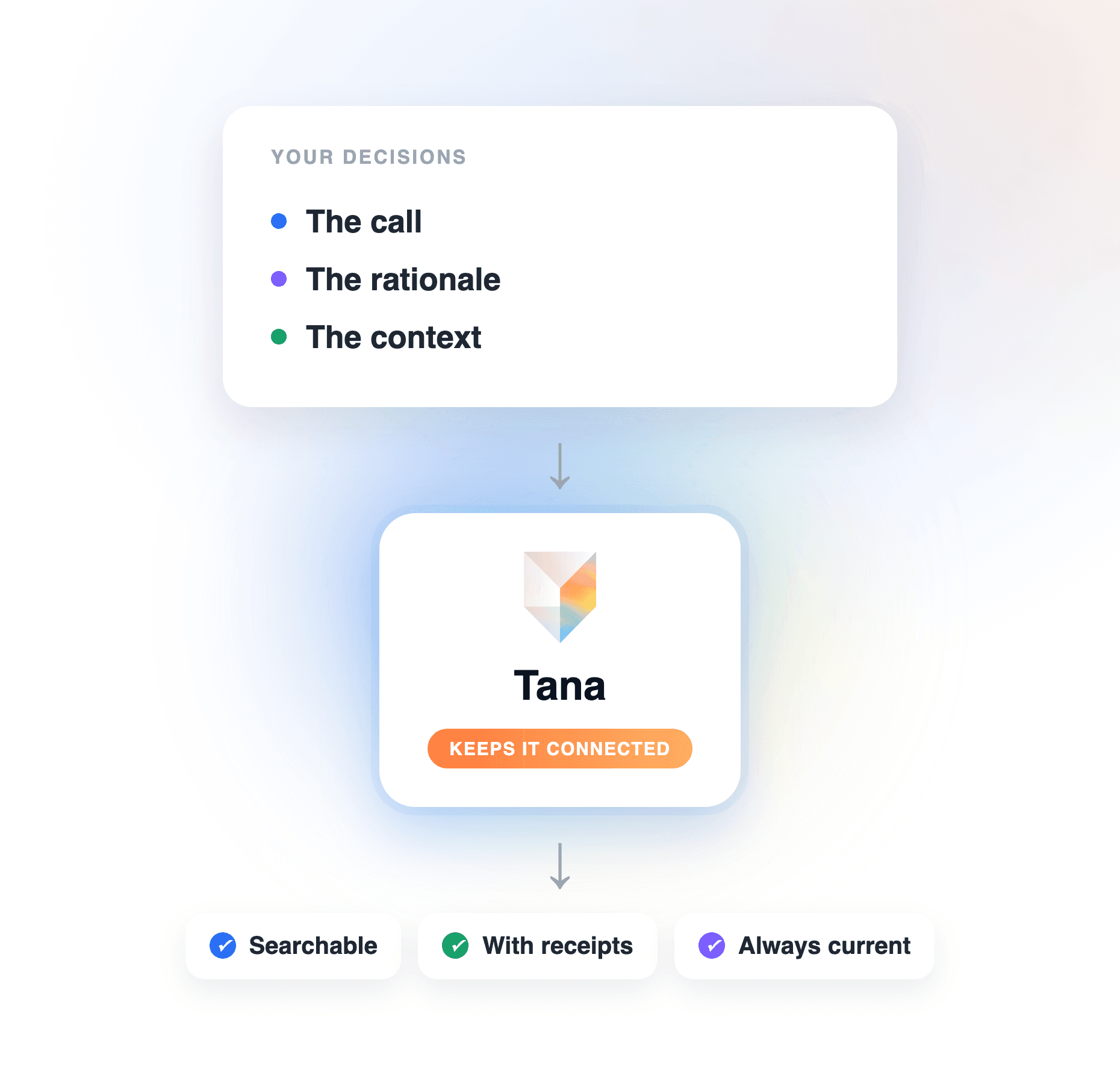
- Tana works as the context layer that captures decisions as connected records straight from your meetings, keeps them current, and answers "why did we decide this" with receipts, without asking you to maintain a graph.
Every team has had the conversation: someone asks why the product works the way it does, and nobody remembers. The decision was made, in a meeting, with good reasons, and then the reasons evaporated. Knowledge graph software exists to stop that loss. This article explains what the category is, why decisions decay in ordinary tools, where these tools fail, and how Tana preserves decision context without asking you to build a graph. If you are comparing products, see Best knowledge graph tools for teams 2026.
What is knowledge graph software?
Knowledge graph software stores knowledge as a network of entities and the relationships between them, rather than as isolated pages. A decision is an entity. So is the meeting where it happened, the person who argued for it, and the project it redirected. The relationships are the point: "decided in", "based on", "supersedes", "affects". Because the connections are explicit, you can traverse them, from a feature back to the decision behind it, from the decision back to the evidence.
For decision tracking, this structure matters more than for most knowledge. A fact stands alone. A decision only makes sense in context: what you knew at the time, what you rejected, what it replaced. Strip the connections and a decision log becomes a list of conclusions with no reasoning.
Run this across a team and the same structure becomes team memory. Knowledge graph software for team memory stores a group's decisions, projects, people, and the links between them as connected, queryable facts rather than flat pages scattered across notes and chat, so context is retrieved instead of reconstructed. That is the difference from a wiki: a wiki holds pages you have to remember to read, while a knowledge graph holds facts you can ask questions of, which is what lets a team query "what did we decide about this, and why" and get a grounded answer months later.
Why decisions rot in notes and chat
Decisions decay faster than other organizational knowledge, and the pattern is consistent:
- The decision and its rationale live in different places. The conclusion goes in the project doc. The reasoning stays in the meeting, or in a chat thread that scrolls away. The link between them exists only in the heads of the people who were there.
- The decision has no date or version. Teams revisit decisions, and without a record of what superseded what, the doc shows two contradictory conclusions and no way to tell which is current. This is the temporal problem: knowledge changes, and flat documents keep no history of the change.
- The decision is disconnected from the work it changed. The ticket got filed, the project pivoted, but nothing ties that work back to the decision that caused it.
- Nobody writes it down at all. The highest-stakes decisions happen mid-conversation, and capturing them is a chore in the moment they occur.
Chat tools make this worse. A decision made in a thread is timestamped but buried, and search returns the argument, not the outcome.
What a knowledge-graph model captures about a decision
Applied to decisions, the graph model preserves four things a flat document loses:
- The decision itself, as a first-class record. Not a sentence in a summary but a record that can be found, referenced, and updated.
- The why. The rationale, the alternatives considered, and the evidence, linked to the decision rather than stranded in a transcript.
- The when. When it was decided, and its relationship to earlier decisions it revises or replaces. This temporal layer lets you reconstruct what the team believed at any point, and it is the part flat notes lose first.
- The connected work. The meeting it came from, the people accountable, the projects it changed. Traverse in either direction: from work to justification, from decision to consequences.
A team with this structure can answer the questions that come up later: why did we build it this way, when did we change course. That is a company decision history you can query, not a pile of documents you search.
Where knowledge graph software fails
The model is sound. The failure modes are practical:
- The graph must be built and fed. Someone defines the entity types, creates the records, and draws the relationships. That is real modeling work, and it competes with the actual job. Most team graphs are abandoned by the quarter's end.
- Capture happens after the fact. The decision occurs in a meeting; the graph entry gets written later, by whoever remembers, in less detail than the moment held. That gap is where rationale dies.
- Stale graphs are worse than no graph. A knowledge management system that confidently returns last year's superseded decision misleads everyone who trusts it. Currency, not structure, is the hard part.
- Query power goes unused. Graph query languages are for specialists. If the team cannot ask a plain question and get an answer, the graph serves its maintainer and nobody else.
The pattern across all four: the graph preserves decision context only if capture and maintenance are close to free. When they cost effort, it decays into the scattered record it was meant to replace.
What this looks like in Tana
Tana approaches the same goal from the opposite end: instead of a graph you build and feed, it is a context layer that captures decisions as connected records from the work itself, mostly from meetings, where decisions actually happen.
- Decisions are captured as they occur. Tana captures your meetings natively, and external Zoom, Teams, or Meet calls without a bot. During the call, the Capture control turns a stretch of discussion into a typed Decision, created in the moment with the conversation attached.
- The rationale travels with the decision. After the call, extraction produces one canonical summary plus the items the conversation pointed at, each a proposal you approve before anything is written. A decision arrives linked to its meeting, its people, and its reasoning.
- Records stay current instead of multiplying. Pin a doc or a Product Track to a recurring meeting and extraction updates that record and de-duplicates, rather than spawning a new summary per call. When a decision gets revisited, the record moves with it: one living record instead of dated fragments.
- You query it in plain language. Ask chat "what did we decide about pricing" or "why did we do it this way" and the answer is grounded in what was recorded, with receipts pointing back to the source.
- The structure fits your team without modeling work. Ask chat to create a custom type, a Decision type with a rationale field, an Insight type, a Bug type with severity and a workflow, and the structure exists. No schema language, no specialist.
- Agents read the same context. Through Tana's Model Context Protocol (MCP) server, agents like Claude Code or Cursor can read and search the decision record while they work, with writes going through proposal review. How that context reaches agents is covered in What is context engineering for AI agents.
The result is the promise of knowledge graph software, decisions connected to their why, their when, and their work, delivered as a side effect of holding the meeting rather than a duty afterward.
Where a general notes tool or chatbot falls short
A capable notes tool or a general chatbot can hold decisions, and for a solo operator with light needs it may be enough. The limits show up at team scale:
- Notes preserve text, not relationships. The decision is findable if you remember the words used. The rationale, the superseded version, and the affected work are separate searches, if they were written down at all.
- A chatbot's memory is personal and unstructured. Paste a transcript into a general assistant and the analysis is good, but it lives in one person's session. The team's decision history cannot accumulate there.
- Neither updates the record. Each meeting produces a new document, so the same decision gets re-summarized across weeks of notes, and no single record reflects the current state.
These tools capture words. Preserving decisions means capturing connections and keeping them current, which is a different job. For the broader tool landscape, see Best organizational memory tools 2026.
Frequently asked questions
What is the best knowledge graph software for capturing company decisions over time?
Look for a tool that captures decisions at the moment they happen, links each one to its rationale and the affected work, keeps records current, and answers plain-language questions. Tana meets that bar as a context layer rather than a graph you maintain: it captures decisions from meetings as typed, connected records you approve, updates the same record as decisions evolve, and answers "what did we decide" in chat with receipts. For a comparison, see Best knowledge graph tools for teams 2026.
How is knowledge graph software different from a wiki or knowledge management system?
A wiki stores pages; a knowledge graph stores entities and relationships, so a decision stays linked to its reasoning, its date, and its consequences instead of being a paragraph somewhere. The tradeoff is maintenance: wikis go stale because nobody updates pages, graphs because nobody feeds relationships. Tana avoids both by capturing the connections from meetings and updating existing records rather than adding new pages, so the decision history stays current without a maintainer.
Can AI answer "why did we decide this" from past meetings?
Yes, if the decisions were captured with their context and the AI is grounded in that record. A general chatbot cannot, because your decision history is not in its memory. In Tana you ask chat directly and get an answer grounded in what was recorded, with receipts pointing to the source, so the answer is checkable rather than plausible.
Do you need to build a data model to track decisions in a graph?
With traditional knowledge graph software, yes: entity types, relationship schemas, and ongoing curation are the adoption cost, and the reason most team graphs stall. Tana removes that step. Ask chat in plain language to create a Decision type with a rationale field and a workflow, and the structure exists, while the records themselves are created from your meetings.
How do you keep a decision history current when decisions change?
Keep one living record per topic instead of a new document per meeting. In Tana, pin the relevant doc or Product Track to the meeting and extraction updates that record and de-duplicates, so a revisited decision revises the existing entry rather than contradicting it from a second document. The history then reflects what is true now, with the trail of how it got there.
Explore further