


TL;DR
- Turn a recorded interview into themes grounded in evidence (who said it, the moment it happened), each tied to a decision and an owned next step. That is a product insight, and it is not the same as a summary. The work is getting there fast, without losing the texture.
- The method is the same whichever tool you use: capture the interview, pull themes from the transcript, ground each theme in evidence, turn it into a decision, file the next step where the work happens, and let patterns compound across interviews.
- AI does the synthesis well. The trap is where the insight lands: paste a transcript into a general chatbot and the result is stuck in one person's session, in no particular structure, gone by the next interview.
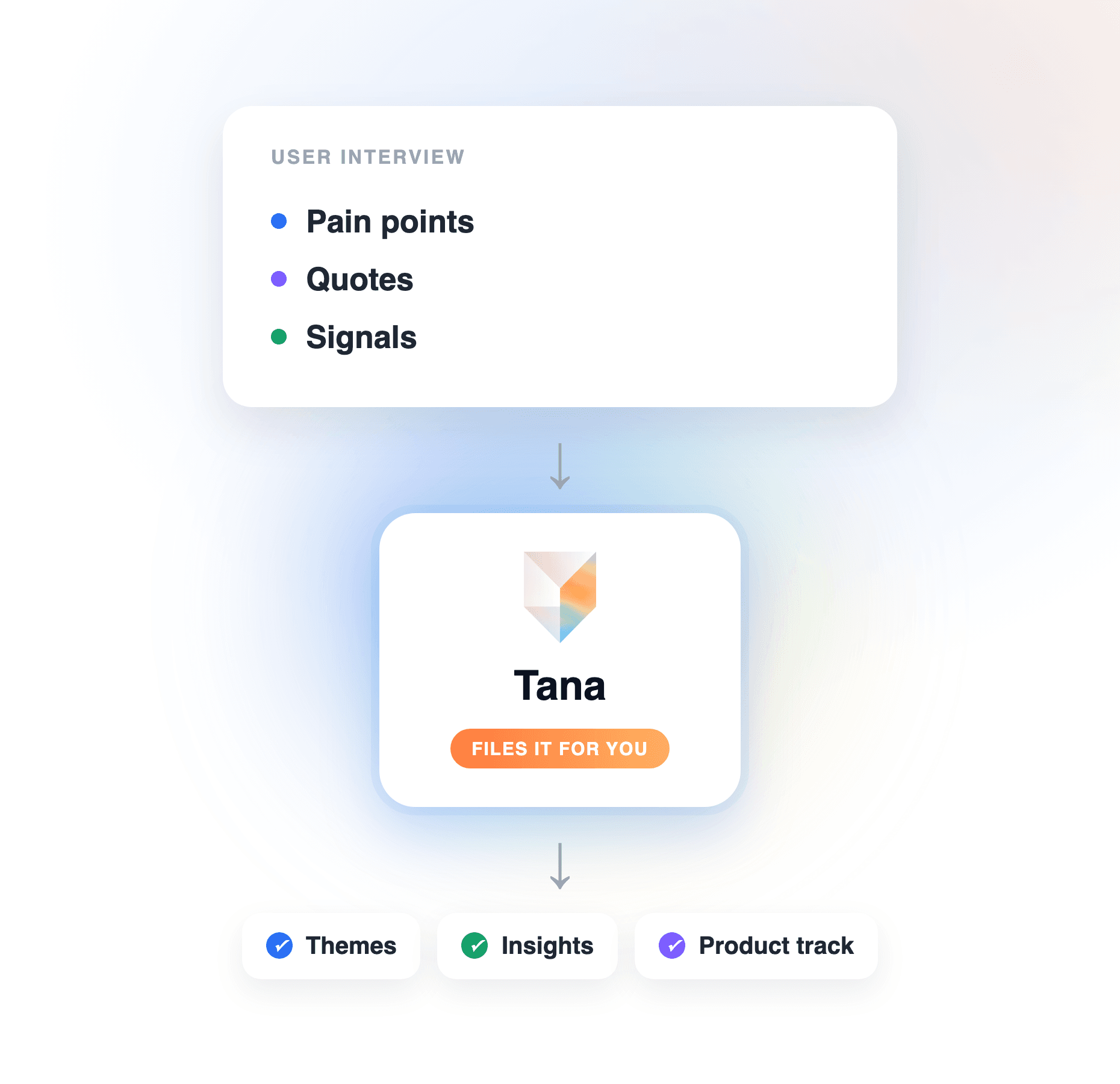
- Tana runs this end to end: it captures and reads the call, turns it into structured product feedback during the session, files it as shared insights your whole team sees, and connects every interview so the 50th is sharper than the first.
User interviews are full of signal and almost impossible to capture by hand. You are listening, asking, and scribbling at once, and the texture is gone by the time you write it up. AI changes that, but "summarize this transcript" is not a product insight, and a pile of one-off summaries is not product research. This guide shows the method, then how Tana runs the whole flow for you: it captures and reads the call and files the insights as you talk, so research compounds across the team instead of dying in a doc.
What counts as a product insight
A quote is raw material. A summary is a recap. A product insight is the thing your team can act on: a recurring theme, grounded in the evidence that supports it, tied to a decision and a next step.
- A theme, not a transcript: "five of eight users abandoned at the invite step," not twelve pages of talk.
- Grounded in evidence: the moment it happened, who said it, ideally the screen they were looking at, so it holds up when someone pushes back.
- Tied to a decision and a next step: what you will change, what you will not, and the filed task that carries it forward.
Everything below is about getting from a recorded conversation to that.
How to turn user interviews into product insights, step by step
The method is tool-agnostic. Under each step is how AI carries it, and how Tana does it specifically.
- Capture the interview cleanly. You cannot analyze what you did not record. Capture audio and, for product interviews, the screen, because where someone struggles is as important as what they say. Tana captures the call without a bot, transcribes it, and reads the shared screen, so you can stop scribbling and actually listen.
- Pull themes from the transcript, not just a summary. Ask the AI to tag pain points, group recurring ones, and surface what repeats, rather than producing a flat recap. In Tana this is a skill: the default product-feedback skill turns the conversation into a summary, the specific pain points, and screenshots of exactly where the user struggled.
- Ground each theme in evidence. An insight a stakeholder can question is an insight that gets ignored. Keep each theme attached to the moment and the screen it came from, not reconstructed from memory. Tana ties each pain point to the point in the call it happened, with the screenshot attached.
- Turn themes into decisions. Insight that does not change a decision is trivia. For each theme, write what you will do, what you will not, and why. Tana captures the decision with the discussion that produced it, so the "why" survives.
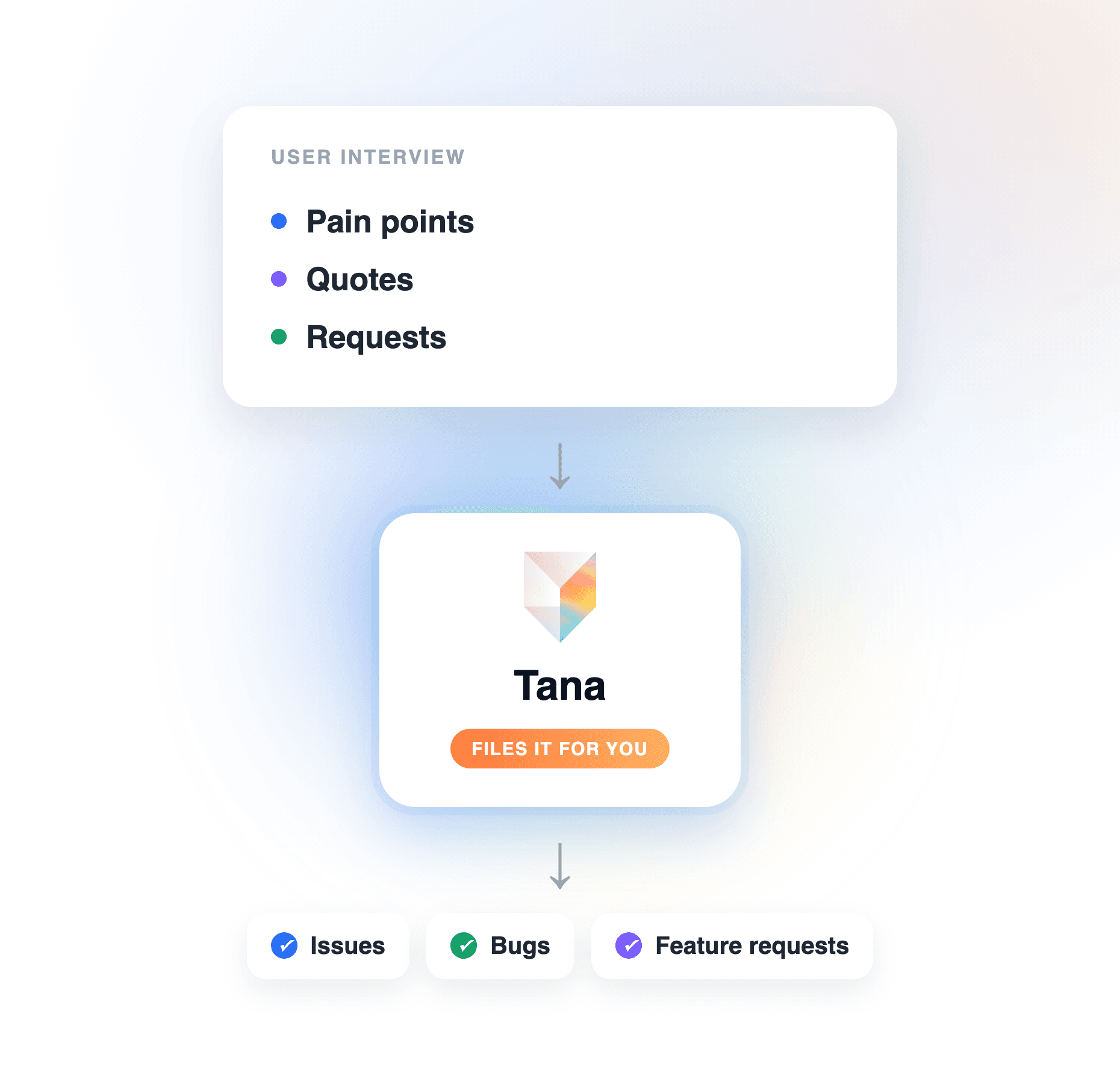
- File the next step where the work happens. A decision with no owner evaporates. Push the action into your tracker as an owned task. From a Tana interview you can send a specific item straight to Linear, GitHub, or Jira, as a proposal you approve.
- Let it compound across interviews. One interview is an anecdote; the pattern across twenty is the insight. The hard part is connecting them without re-reading everything. Tana files every interview into the same shared insights and de-duplicates as it goes, so the third customer to hit the same wall, and the feature five interviews keep circling, surface on their own.
Doing it in Tana
In practice the whole loop happens around the call itself. The full walkthrough is in Turn a customer call into product feedback; the short version:
- Run the interview in Tana and ask the user to share their screen. Tana transcribes and reads the screen as you talk.
- Run the product-feedback skill from the meeting or chat. You get a summary, the specific pain points, and screenshots marking exactly where they struggled, tied to the moment, not reconstructed afterward.
- Add a customer-journey map if you want the bigger picture, ready to share with the product team as is.
- File it as shared insights. Review the proposal, accept it, and the pain points land as structured insights in your team's space, so the whole team sees them, not just you. Push the ones ready to act on to your tracker.
Because every interview files into the same shared context, your team's understanding of its users gets sharper with every conversation, and the AI draws on all of it. That is the difference between doing research and accumulating it.
For technical teams: take it into the code
The insight does not have to stop at the product team. Because Tana runs an MCP server, you can stay in Claude Code while you build and ask it to pull the relevant user insights straight from Tana, the pain points behind the ticket you are working on, so you are coding against what users actually said. When the fix is done, the same connection syncs it back to the product track in Tana as a proposal you approve. The research reaches the code, and the code updates the research, with no copy-paste in either direction.
Why a general AI chatbot is not enough
You can paste a transcript into a general assistant and get a decent summary back. For a single interview you are analyzing alone, that is fine. It stops being enough the moment it is a team's product research:
- The context is trapped in one person's session. The insight lives in your chat history, not somewhere the product team works from. The next person starts over.
- Nothing is tied to your product. A generic summary is not a filed ticket, an owned decision, or a journey map your team can act on.
- It does not compound. Each transcript is analyzed cold. There is no shared record where the 50th interview builds on the first, so patterns across interviews are yours to spot by hand.
A general chatbot is a fine place to think through one conversation. Turning a stream of interviews into product insight your team builds on is a different job, and the reason a purpose-built tool wins.
The payoff
Done well, user research stops being a thing you write up and starts being something that accumulates. Each interview leaves behind structured insight the whole team can see, tied to decisions and filed next steps, and connected to every interview before it. The method matters more than the brand: capture, theme, ground, decide, file, compound. Get those six right and the 50th interview is sharper than the first, because the tool remembered the other 49.
Frequently asked questions
How do you turn user interviews into product insights using AI?
Record and transcribe the interview, then have AI pull themes (recurring pain points) rather than a flat summary, keep each theme tied to the evidence it came from, turn it into a decision, and file the next step as an owned task. The piece teams miss is the last one: making the insight shared and cumulative. Tana does the whole loop from the call itself, turning the conversation into structured product feedback and filing it as shared insights your team can act on.
Can ChatGPT analyze user interviews?
Yes, for a single transcript you paste in, it will summarize and find themes well. The limit is that the result stays in your individual session, in no particular structure, and does not connect to your other interviews or your product. For a team turning many interviews into compounding product insight, a tool that captures the call and files shared, structured insights, like Tana, is purpose-built for the job.
How do you find themes across multiple interviews?
Themes across interviews only surface if the interviews live in one connected place and get de-duplicated as they accumulate, otherwise you are re-reading transcripts to spot repeats. Tana files every interview into the same shared insights and connects them, so recurring pain points, the same wall hit by the third customer this month, surface on their own instead of being reconstructed by hand.
How do you get from insights to decisions and next steps?
For each theme, write the decision it drives (what you will change and what you will not) and capture the reasoning alongside it, then file the action as an owned task in your tracker. In Tana a decision is logged with the discussion that produced it, and you can push a specific item to Linear, GitHub, or Jira as a proposal you approve, so the next step has an owner and the "why" is not lost.
Can developers use the interview insights while coding?
Yes. Because Tana exposes an MCP server, a coding agent like Claude Code can pull the relevant user insights from Tana while you work, so you build against what users actually said rather than a second-hand ticket, and then sync the fix back to the product track in Tana as a proposal you approve. The interview that surfaced the problem and the code that fixes it stay connected.
What is the best AI tool for analyzing user interviews?
For solo, one-off analysis, a general assistant is enough. For product teams who interview continuously and want the insight to be shared, structured, and compounding, the better fit is a tool built around the call itself. Tana captures and reads the interview, produces structured product feedback during the session, and files it as shared insights, so research accumulates instead of scattering across documents and chat histories. See also Best AI meeting assistants 2026.
Explore further