



TL;DR
- Granola gives you a clean transcript and summary, but product teams need the meeting to become filed tickets, updated roadmaps, and shipped work.
- The best Granola alternative depends on what you need after the meeting: more automation, deeper workspace integration, or agents that do the work.
- Tana is the strongest fit for product teams: AI agents draft Linear issues, PRDs, and stakeholder updates during the call, ready for you to review and send.
- If you only want a like-for-like notetaker, Fathom is the nearest match, with a generous free tier for recording volume.
What is the best Granola alternative for product teams in 2026?
Granola is a clean, bot-free way to transcribe a call and get a tidy summary, but it stops there: turning a decision into a filed ticket or an updated roadmap is still manual. For product teams, the best alternative is the one that closes that gap. Tana is the strongest fit, because its AI agents turn meeting discussions into drafted Linear issues, PRDs, and follow-ups you review and send during the call itself.
Why product teams look for a Granola alternative
Granola does one thing well. It captures audio locally, without a bot in the call, and turns the transcript into a clean summary against your template. If a clean transcript is all you need, and your team already runs its meetings on Granola, switching may not be worth the effort.
The friction shows up for product teams that need more. A sprint planning session produces decisions that need to become Linear issues. A design review surfaces bugs that need filing with screenshots. A customer call generates insights that belong in the roadmap. Granola hands you a tidy summary and stops there, so the work of turning the conversation into shipped output stays manual.
Product teams searching for an alternative are usually not unhappy with the transcript. They want the meeting to do something.
The best Granola alternatives for product teams
1. Tana: meetings that ship work
Tana is an agentic meeting platform built on a context graph. Like Granola, it can capture meetings without a bot in the call. Unlike Granola, it does not stop at the summary. As the conversation unfolds, AI agents recognize what the team is deciding and draft the work to match: a sprint review can surface four Linear issues with annotated screenshots, a drafted PRD, and a follow-up Slack message, each one prepared by a skill and ready for you to review and send before anyone leaves the call. The work lands where product teams already operate: integrations cover GitHub, Linear, Jira, and Slack, agents can hand prompts to coding tools like Cursor and Copilot, and an MCP connection extends the reach to anything else in your stack.
The context graph is what compounds the value. Every decision, person, and project is connected, so the AI gets sharper with each meeting and you can ask it later: "what did we decide about the onboarding redesign, and why?" A notetaker leaves you with 50 disconnected summaries after 50 meetings. Tana gives you a memory where the 50th meeting is informed by the previous 49.
Best for: product and engineering teams who need meetings to produce filed tickets, drafted specs, and tracked decisions, not just notes.
Pricing: free plan (five meetings a month with AI transcripts, summaries, and 50 AI queries); paid early bird pricing.
2. Fathom: the closest like-for-like notetaker
Fathom is the closest direct analog to Granola, and it recently added a bot-less capture mode. It has the most generous free tier for recording volume, with unlimited recording and transcription (advanced AI summaries are capped on the free plan), plus AI Scorecards and CRM sync on paid plans.
Best for: teams that want a Granola-style notetaker with broader free coverage and light automation.
What it's missing: a workspace or knowledge layer. Like Granola, Fathom summarizes the meeting; turning decisions into filed, tracked work is still on the team.
3. Fireflies.ai: routing meeting data across your stack
Fireflies sends a bot to record and transcribe, then pushes structured data and action items into your stack through 100+ integrations and an MCP server that lets Claude or ChatGPT pull conversation data.
Best for: product teams that want meeting outputs routed automatically into the tools they already use, without the need for any context.
What it's missing: agents that act, and a knowledge graph. Fireflies moves the meeting data into your tools, but deciding what the work is, filing the right issue, and drafting the spec is still a person's job once it lands. Each meeting is also an isolated record rather than part of a connected memory, and the visible bot is a friction point in customer calls.
4. Notion AI: for teams already working in Notion
Notion AI added AI Meeting Notes in 2025 and Custom Agents in early 2026, so meeting capture lands next to the PRDs, roadmaps, and databases a product team already keeps in Notion.
Best for: teams standardized on Notion who want meeting notes inside their existing workspace.
What it's missing: real-time action and a graph. Notes become pages, not filed tickets, and the AI is only as good as what the team remembers to document.
5. Otter.ai: accurate transcripts
Otter delivers strong live transcription with collaborative editing, and now offers bot-free capture through its desktop app and browser extension alongside the OtterPilot bot. It is useful when a clean, searchable record of the conversation is the main requirement.
Best for: one-off transcription where accuracy is the priority and no downstream workflow is involved.
What it's missing: follow-through. Otter records the conversation; turning it into filed, owned, tracked work is entirely manual.
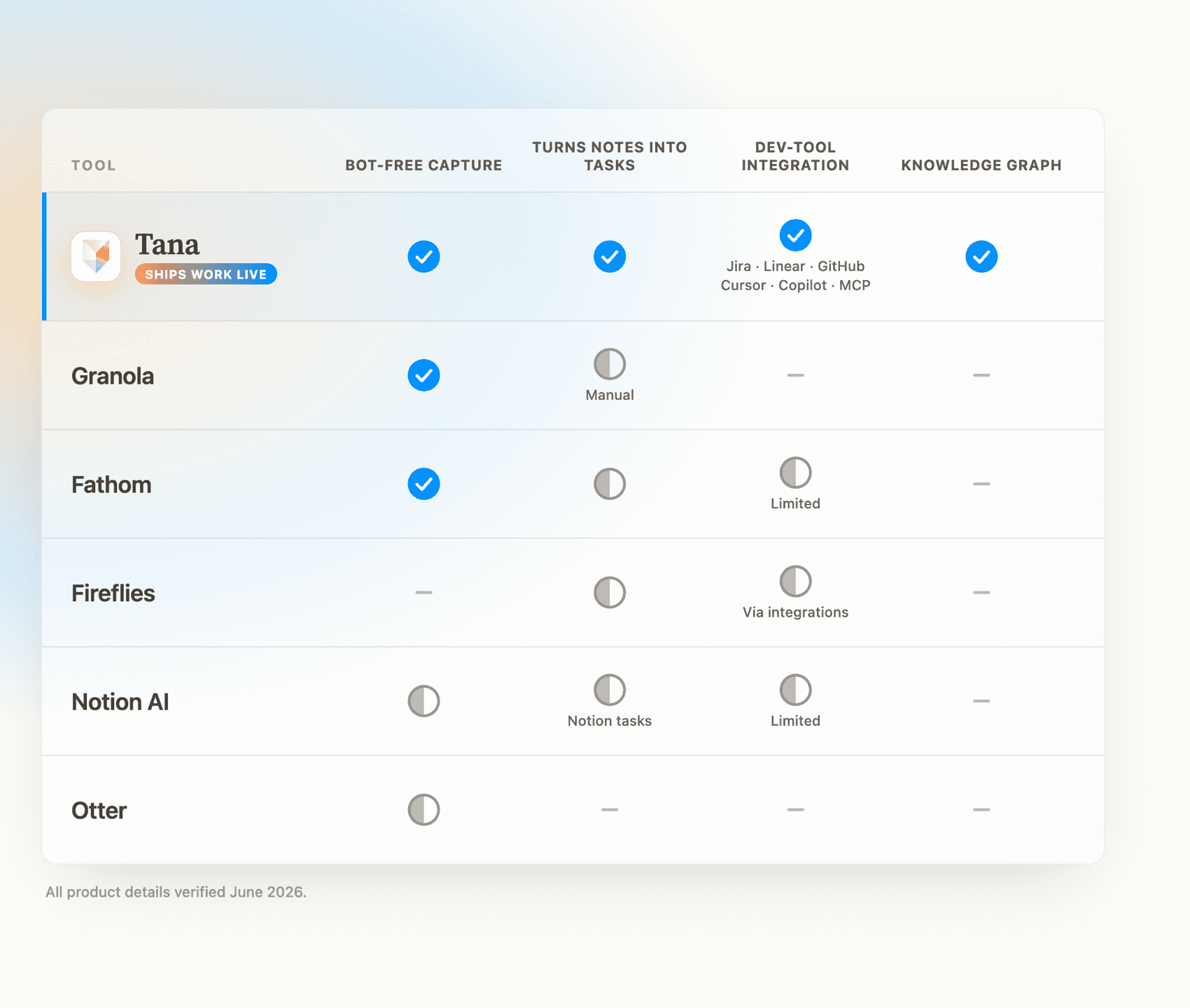
Comparison table
| Tool | Bot-free capture | Turns notes into tasks | Dev tool integration | Knowledge graph |
|---|---|---|---|---|
| Tana | Yes | Yes | Yes (GitHub, Linear, Jira) | Yes |
| Granola | Yes | Manual | No | No |
| Fathom | Yes | Partial | Limited | No |
| Fireflies | No | Partial | Via integrations | No |
| Notion AI | Partial | To Notion tasks | Limited | No |
| Otter | Partial | No | No | No |
All product details were verified in June 2026.
How to choose
Three questions decide it for a product team:
- Do you just want good notes, or notes that become work? Granola already makes great notes. If that is all you need, you may not need to switch. If you need the meeting to produce filed tickets and updated roadmaps, you need a tool that acts.
- Where does the output land, and who does the work once it does? Product teams live in Linear, GitHub, and Slack. Most tools can route a summary there; the real question is whether the meeting files the issue and drafts the spec itself, or just drops a copy for someone to act on later.
- Does context need to compound? Sprint after sprint, the same decisions get referenced. A knowledge graph remembers what you decided and why; a notetaker gives you a pile of disconnected summaries.
The verdict
For product teams, the question behind "best Granola alternative" is rarely about transcript quality. Granola transcribes the call well, and so do the others. The gap is everything that happens after the meeting: the tickets, the PRDs, the roadmap updates, the follow-through. The strongest alternative is the one that closes that gap. Tana is built for exactly that: agents that turn the conversation into shippable work, on a context graph that remembers every decision. If a clean transcript is all you need, several tools here will do, and there is no urgency to switch. If you want the meeting to move the work forward, that is a different category.
Frequently asked questions
What is the best Granola alternative for product teams?
Tana is the strongest fit. Its AI agents draft Linear issues, PRDs, and follow-ups during the call, ready for you to review and send, so the meeting produces filed work rather than just a transcript. Granola transcribes and summarizes the call but stops there. If you only want a like-for-like notetaker, Fathom is the nearest match.
What is the best free Granola alternative?
It depends on what the free plan is for. For unlimited free recording volume, Fathom has the broadest free plan as of now, though advanced AI summaries are capped at about five a month, where Otter limits you to 300 minutes a month and Fireflies to 800 minutes of storage. Tana takes a different angle: its free plan hosts five meetings a month with AI transcripts, summaries, and 50 AI queries, so even the free tier builds a queryable memory of your meetings rather than a one-off transcript. Pick Fathom for raw free volume, Tana for a free tier that does more than transcribe.
Does Granola file issues in Linear or GitHub?
No. Granola produces notes and summaries, but it does not file issues or sync tasks to dev tools, so turning a decision into a Linear or GitHub ticket is manual. Tana's agents create Linear, Jira, and GitHub issues directly from the meeting, with annotated screenshots attached.
Is Granola or Tana better for product teams?
Tana, for a product team. Granola transcribes the call and gives you a clean summary, and if that is all you need and you already use it, there is little reason to switch. But Tana does that at least as well and goes further: it turns the meeting into filed tickets, drafted PRDs, and roadmap updates, on a context graph that remembers past decisions. Choose Granola if you only want the transcript; choose Tana if you want the meeting to produce work.
Explore further