



TL;DR
- An investment memo is not a meeting summary. It is a structured record of the deal: thesis, team, market, traction, risks, open questions, kept current across every founder conversation.
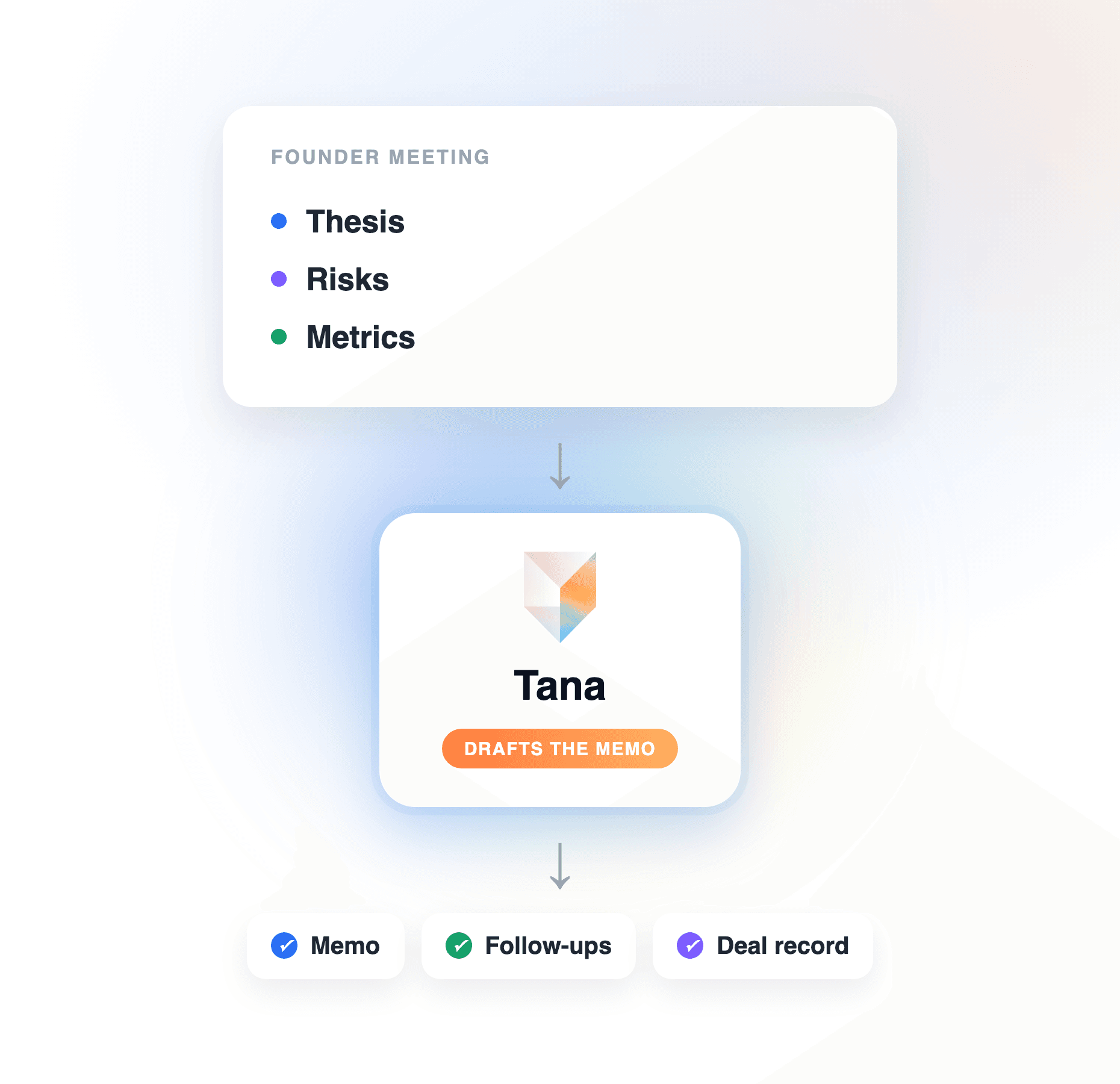
- The method: capture the founder call cleanly, extract the thesis, risks, metrics, and open questions as structured items, draft the memo from those items, file the diligence follow-ups, and make sure the next call updates the same record instead of starting a new one.
- Most investment memo tools stop at the summary and leave the memo, and the deal memory, to you. Tana runs the loop: it captures the call without a bot, drafts the memo as a structured document you shape, and updates the same deal record call after call.
- Everything Tana writes arrives as a proposal you approve, so the memo stays yours, drafted for you rather than by you.
A founder call is dense: the pitch, the numbers, the caveats, the thing they said about churn in minute forty. The memo you owe your partners afterwards is structured, and writing it usually costs an hour you spend reconstructing what you half-noted. This guide shows how to build the memo in Tana instead, from the call itself, and how to keep one deal record current across the whole raise. If you want the tool landscape first, the comparison is in Best AI tools for VC meeting memos in 2026. This piece is the how.
What a working investment memo needs
Before the steps, the bar. A memo your fund can act on has three properties a call summary lacks:
- Structure. Thesis, team, market, traction, risks, terms, open questions. Sections a partner can navigate, not a wall of bullets.
- Evidence. The metric the founder quoted, the moment they qualified it, the deck slide they showed. Claims a skeptical partner can trace back to the conversation.
- Memory. The second call should sharpen the memo, not spawn a second one. "How has the burn story changed since March" is a memo question, and it only has an answer if the record is one record.
Everything below is about getting those three from a recorded conversation.
How to build the memo, step by step
Step 1: capture the founder call without changing it
You cannot draft a memo from notes you took while also running the meeting. Record the call, and record the screen, because the deck and the metrics dashboard are half the evidence.
For an early founder conversation, a visible recording bot joining as a participant changes the tone. Tana captures meetings natively, and captures external Zoom, Teams, or Meet calls without a bot: the desktop app records the audio and takes screenshots of whatever the founder screen-shares. The call stays a conversation, and you keep the full record, deck slides included.
Step 2: mark the moments that matter, as they happen
Some things deserve structure the moment they are said. During the call, Tana's Capture control turns a stretch of discussion into a typed item: a Decision, a Task, or any custom type you have defined. Ask chat in plain language to create the types your fund thinks in, an open-question type with an owner, a risk type with a severity and a status workflow, and capture into them live. The founder addresses the churn number, you capture it as a metric claim. A partner raises a concern, you capture it as a risk. Thirty seconds each, and the memo's skeleton exists before the call ends.
Step 3: let extraction structure the rest
After the call, Tana's extraction produces one canonical summary plus the individual items the conversation pointed at: the follow-ups, the questions the founder left open, the claims worth verifying, each assigned to the person the discussion aimed it at. Nothing is written silently. Everything arrives as a proposal you review, so you accept the items that belong in the deal record and reject the noise. The judgment stays with you; the transcription and sorting do not.
Step 4: draft the memo as a document you shape
This is where most tools hand you a template and wish you luck. In Tana, you ask for the memo and Tana drafts it from the call: a structured document, or a deck artifact with a hero slide, takeaway cards, and action items, generated from the transcript rather than typed from memory. You edit it inline, reshape the sections, cut what does not hold, and share it with the partnership by link.
Treat the memo as a generated structured record you shape, not a formal export. The content exports as Markdown, so if your fund's IC wants a house-format document, this is the source you finish from, with the drafting hour already spent for you.
Step 5: file the diligence follow-ups where they get done
A memo full of open questions that nobody owns is a stalled deal. From the same extraction, file the follow-ups into the tools your team already runs on, including HubSpot, Pipedrive, and Slack, and anything else that speaks Tana's Model Context Protocol (MCP) server, each as a proposal you approve, with the relevant screen-share screenshots embedded. "Get the cohort data behind slide 12" lands as an owned task with slide 12 attached.
Step 6: pin the deal record so every call updates the same memo
This is the step that turns a memo into deal memory. Pin the deal record to the next meeting with that founder, and extraction updates that record: new claims merge in, duplicates get folded, and the memo reflects the whole relationship rather than the last call. Across a raise, that means one living memo instead of five summaries you reconcile yourself the night before IC.
Before the next call, a scheduled agent can brief you from the same record, leaving a prep doc with the open questions, the last metrics, and what changed. You walk in already caught up.
What this looks like across a deal
In practice: first call, captured bot-free, memo drafted by Tana, shaped by you, four diligence items filed. Second call three weeks later, the pinned deal record absorbs the update, the burn numbers change in place, two open questions close, one new risk appears. Before the partner meeting, you ask chat "what did the founder say about enterprise pipeline, and has it changed" and get an answer grounded in the recorded calls, with the receipts. The memo the IC reads is not a document someone assembled the night before. It is the deal's own record, current as of the last conversation.
Where a general chatbot falls short
You can paste a founder-call transcript into a general assistant and get a respectable memo draft. For a one-off call you are evaluating alone, that works, and it is honest to say so. It stops working the moment the deal is a relationship:
- Each call is analyzed cold. The chatbot has no memory of the March call when it drafts from the June one, so the "how has the story changed" question, the one that matters most, has no answer.
- The draft is stranded. It lives in your chat session, not in a record your partners work from, and nothing in it becomes an owned diligence task.
- The evidence is gone. A pasted transcript carries no deck slides, no screenshots, no link back to the moment a claim was made.
A chatbot is a fine drafting aid for one conversation. A deal is many conversations, and the memo that compounds across them needs a system that captures, remembers, and files, which is the job Tana is built for.
Frequently asked questions
What is the best tool for writing VC investment memos from founder meetings?
For investment teams, the strongest fit is a tool that drafts the structured memo from the call itself and keeps one deal record current across every founder conversation, rather than producing a per-call summary. Tana does both: bot-free capture, a memo drafted as a document you shape, follow-ups filed as proposals, and a pinned deal record every call updates. The full comparison of the category is in Best AI tools for VC meeting memos in 2026.
Can AI write an investment memo from a founder call?
Yes, and the useful question is what it writes into. Any capable model can draft memo prose from a transcript. Tana drafts the memo from the captured call as a structured document or deck you edit inline and share by link, grounded in the actual conversation, with the screen-shared slides captured alongside. You review the draft rather than write it, and the result lives in the deal record, not a chat window.
How do VCs keep deal context across multiple founder meetings?
Keep one record per deal and make every meeting update it. In Tana you pin the deal record to each call with that founder, and extraction updates the existing memo and de-duplicates instead of creating a new summary per meeting. Later you can ask chat "what did we decide" or "how did the metrics change" and get an answer drawn from every recorded conversation, with receipts.
Does a recording bot have to join the founder call?
No. Tana captures external Zoom, Teams, and Meet calls without a bot: the desktop app records the audio and screenshots the screen-share. For early-stage conversations where a visible bot changes the dynamic, that keeps the call natural while preserving the full record, deck included. Native Tana meetings are captured directly.
How do memo insights turn into diligence follow-ups?
In Tana, extraction turns the open questions from a call into assigned items, and you file them into the tools your team already uses, including HubSpot, Pipedrive, and Slack, plus anything reachable through Tana's MCP server. Each lands as a proposal you approve, with relevant screenshots embedded, so "verify the retention cohort" becomes an owned task carrying the exact slide it refers to.
Explore further